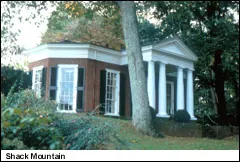
Fiske Kimball spent his career restoring Thomas Jefferson's reputation as an architect. Then he built himself a house to prove he meant it.
Designed in 1935–36 as a personal retreat, Shack Mountain sits about two miles north of Charlottesville on land the Shackelford family settled in the eighteenth century — the name stuck, over Kimball's preferred Tusculum. The design follows Jefferson's plan for Farmington: a one-story, T-shaped house with octagonal projections at the front, a Tuscan portico with paired stucco columns, triple-hung sash windows, Chinese Chippendale balustrades. The front door opens into a round vestibule, which leads through a curved door into a half-octagonal parlor — an adaptation of Pavilion IX at the University of Virginia, the institution Kimball founded a school of architecture within. Kimball and his wife Marie used the house as a retreat until both died in 1955, willing it to the Philadelphia Museum of Art, where Kimball had been director.
It became a National Historic Landmark in 1992, specifically for Kimball's place in American architectural history. Jefferson's shadow falls long across this part of Virginia. Shack Mountain is what it looks like when the scholar builds for himself.
- ·NHL specifically because of Kimball's importance in American architectural history.
Memories
Editorial content compiled with AI assistance. Place details verified against public records.