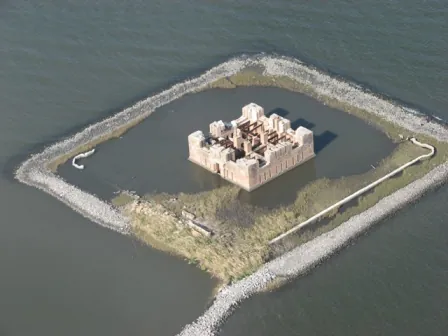
Construction began in 1856 on the shore of Lake Borgne, where Bayou Yscloskey meets the water. P.G.T. Beauregard supervised the work with architect J.G. Totten, raising brick walls as part of the Third System of U.S. coastal defenses. The fort was intended to protect water routes toward New Orleans. In 1814, the British Army had attacked the city after their navy advanced up Lake Borgne and defeated a small flotilla of American gunboats in the Battle of Lake Borgne. At the time Fort Proctor was built, there was also an adjacent railroad port called Proctorville.
Hurricane damage caused delays. The outbreak of the Civil War interrupted construction. The fort was never garrisoned. By the end of the war, improvements in artillery had made the design obsolete. Confederate forces occupied it briefly, then abandoned it. It never fired a shot in combat.
The design included two innovations: comfortable living quarters with bathrooms, and extensive use of structural iron in its construction. In the 1940s and 1950s, before it was engulfed by Lake Borgne, the ruins were a popular gathering place for teenagers seeking a spot where they would not be supervised. The construction of the Mississippi River-Gulf Outlet Canal in the 1960s cut off all land access. In 1978, it was listed on the National Register of Historic Places.
Now the brick ruin rises from the marsh — walls collapsing into the water, one of the most photographed ruins in Louisiana. It is completely surrounded by water about one foot deep. Before Hurricane Katrina, there remained one small piece of dry land inside. Coastal erosion and subsidence are slowly consuming the structure. It may not survive another generation.
You can see it in the distance from Shell Beach. Charter services from Shell Beach or Hopedale can arrange trips. There is no dock, no facilities. Bring everything you need and watch for alligators.
- ·Construction began in 1856 as part of the Third System of U.S. coastal defenses. The Civil War interrupted the work and the fort was never completed.
- ·The brick ruin rises from the marsh of Lake Borgne — walls collapsing into the water, one of the most photographed ruins in Louisiana.
- ·Never fired a shot in combat. It was briefly occupied by Confederate forces, then abandoned.
- ·Coastal erosion and subsidence are slowly consuming the structure. It may not survive another generation.
- ·Accessible only by boat. Charter services from Shell Beach or Hopedale can arrange trips.
- ·No facilities, no dock. Bring everything you need and watch for alligators.
Memories
Editorial content compiled with AI assistance. Place details verified against public records.