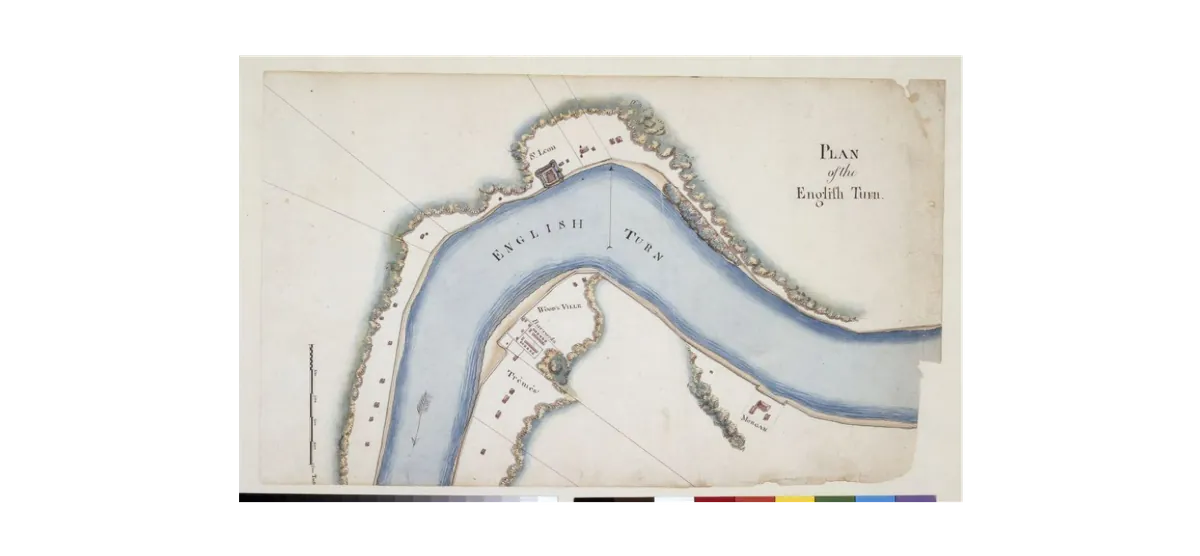
In 1699, French explorers Sauvolle and Jean-Baptiste Le Moyne de Bienville were exploring the lower Mississippi when they encountered English ships. Bienville was successful in ordering the English out of the river. The bend took the name English Turn.
The site mattered because of what came after. Bienville had recognized something in this geography — the strategic value of controlling the river's passage. When he founded New Orleans in 1718, he selected a site along a sharp bend of the flood-prone Mississippi, where the river had created a natural levee on relatively high ground. The location offered control of the entire Mississippi River Valley, at a safe distance from Spanish and English colonial settlements. It sat adjacent to an ancient trading route and portage between the Mississippi and Lake Pontchartrain via Bayou St. John — a path Native Americans had used for trade, one that offered access to the Gulf without navigating the hundred miles of river below.
The city Bienville built became the largest port in the Southern United States through the nineteenth century, exporting most of the nation's cotton and other farm products to Western Europe and New England. During the War of 1812, the last major battle was the Battle of New Orleans in 1815. As the largest city in the South at the start of the Civil War, it was an early target for capture by Union forces.
English Turn is now a gated community containing private property, a golf and country club, and swimming and tennis facilities. The name on the map records the 1699 encounter — when Bienville, exploring a river that would define a city, turned back the English at a bend that still bears the moment's name.
Memories
Editorial content compiled with AI assistance. Place details verified against public records.