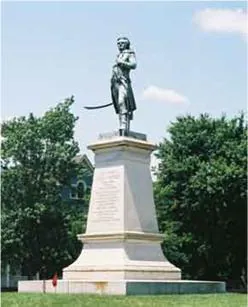
The monument stands in the median on Washington Avenue — the inscription reads, "in testimony of his virtues, and their gratitude." Hugh Mercer died January 12, 1777, nine days after British bayonets found him on a winter field near Princeton, New Jersey. He'd been mistaken for George Washington, surrounded, and beaten to the ground. Multiple bayonet wounds to his body, blows to his head. Left there. When they found him, they carried him to a field hospital; Benjamin Rush worked to save him, but the damage was done.
Mercer wasn't born American. He studied medicine at the University of Aberdeen, joined Bonnie Prince Charlie's doomed Jacobite rising, and fled Scotland after Culloden in 1746 — a fugitive at twenty. He landed in Pennsylvania, practiced as a physician, then served alongside Washington in the French and Indian War. The two became close. In 1760, Washington recommended Fredericksburg, and Mercer moved south, opened an apothecary, married, raised five children. The shop still stands in town, now a museum. Washington later sold him Ferry Farm, the childhood home across the river.
When the Revolution came, Mercer was appointed brigadier general. He oversaw the building of Fort Lee on the New Jersey side of the Hudson. He led the raid on Staten Island in October 1776, took prisoners from the makeshift hospital at St. Andrew's Church, then pulled back under fire. Some accounts credit him with suggesting the crossing of the Delaware — the move that turned Trenton. Three days after that victory, leading a vanguard of 350 men toward Princeton, he met two British regiments in an orchard grove. His horse was shot. He drew his saber. They took him down.
Legend has it that Mercer, with a bayonet still impaled in him, did not want to leave his men and the battle and was given a place to rest on a white oak tree's trunk. The tree became known as the Mercer Oak; it's on the seal of Mercer County, New Jersey now. Washington rallied Mercer's scattered men, pushed the British back, won Princeton. The crisis of the Revolution ended. Most of the army re-enlisted. The French approved arms. Cornwallis pulled his forces back to New York. Public support in Britain began to crack.
Fredericksburg raised this monument to the man who left.
- ·Coordinates approximate. Confirm exact location before publishing.
Memories
Editorial content compiled with AI assistance. Place details verified against public records.