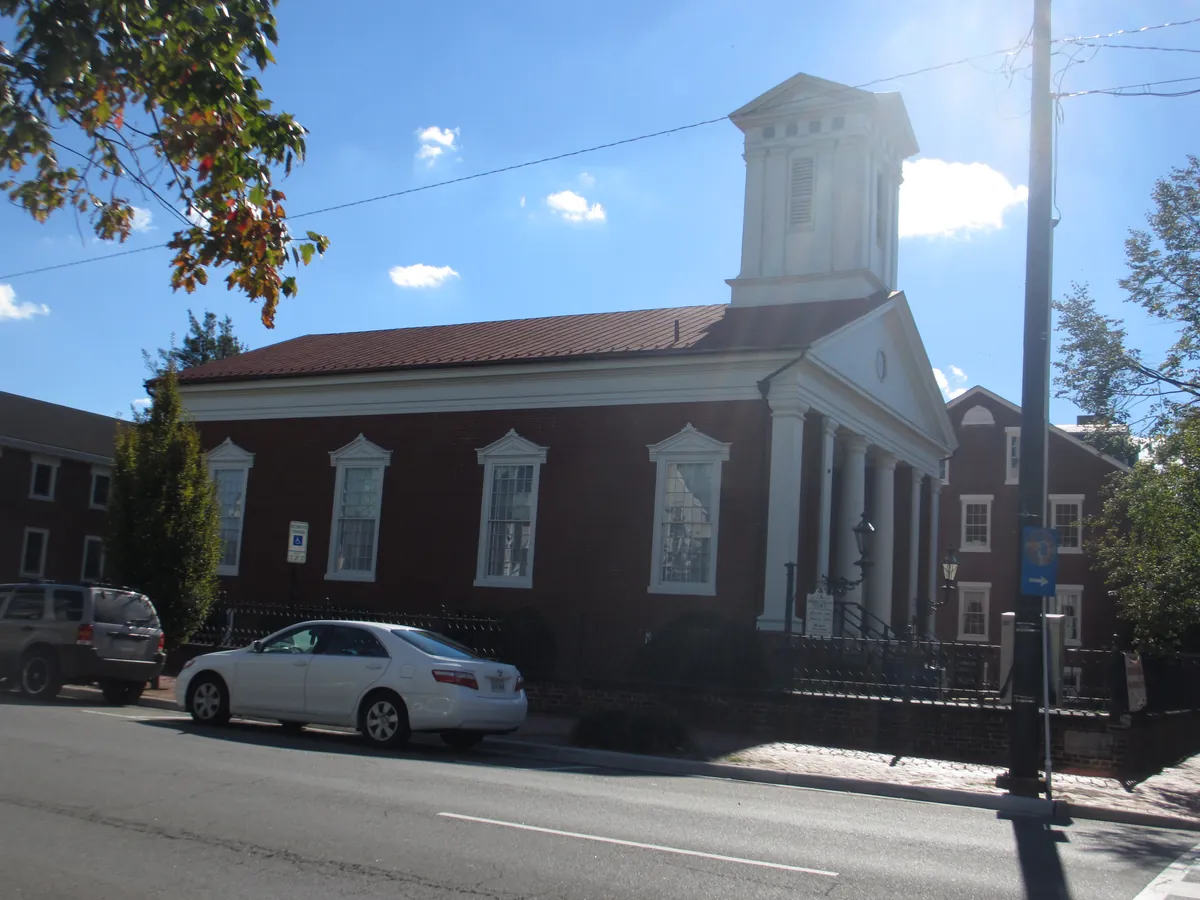
Halfway between Washington and Richmond — that geography wrote Fredericksburg's fate. During the Battle of Fredericksburg, December 11 through 15, 1862, Union forces bombarded the port town and occupied what remained. Buildings shattered. Civilians fled. The town that had thrived as a colonial tobacco port at the fall line of the Rappahannock became wreckage caught between capitals.
Walk the 40-block Historic District today and you're walking through what didn't burn. More than 350 buildings and sites date to the 18th and 19th centuries — the Fredericksburg Town Hall and Market Square, the Lewis Store, the former site of the Slave Auction Block. Scars in brick. Cannonball marks still lodged in walls, so they say. What the war couldn't finish became the core of a town that took decades to rebuild.
During the battle, nearly 10,000 enslaved people left area plantations and city households, crossed the Rappahannock to Stafford County, and reached Union lines. John Washington, a literate enslaved man from Fredericksburg who crossed to freedom, wrote later about watching Union troops approach from across the river: "No one could be seen on the street but the colored people, and every one of them seemed to be in the best of humors." His manuscript, discovered in the 1990s, became the basis for two books. In 2010, the National Park Service, Stafford County, and the city posted historical markers on either side of the Rappahannock as part of a "Freedom Trail" to mark the exodus.
Neither the city nor the surrounding counties reached their 1860 population again until well into the 20th century. The tobacco trade didn't come back. After the war, many freedmen moved to Richmond and Petersburg, where established free Black communities and more work existed. What remained downtown became the bones of a city whose location had made it a target — and whose survival became its own story.
- ·Multiple standing downtown buildings retain visible cannonball holes and bullet damage from the December 1862 Union artillery bombardment preceding the Battle of Fredericksburg. A walkable concentration along Caroline, Sophia, and Princess Anne Streets. The bombardment was the opening move before the Union assault on the Sunken Road — the damage is still readable in the brick 160+ years later. Source: firsthand observation.
Memories
Editorial content compiled with AI assistance. Place details verified against public records.