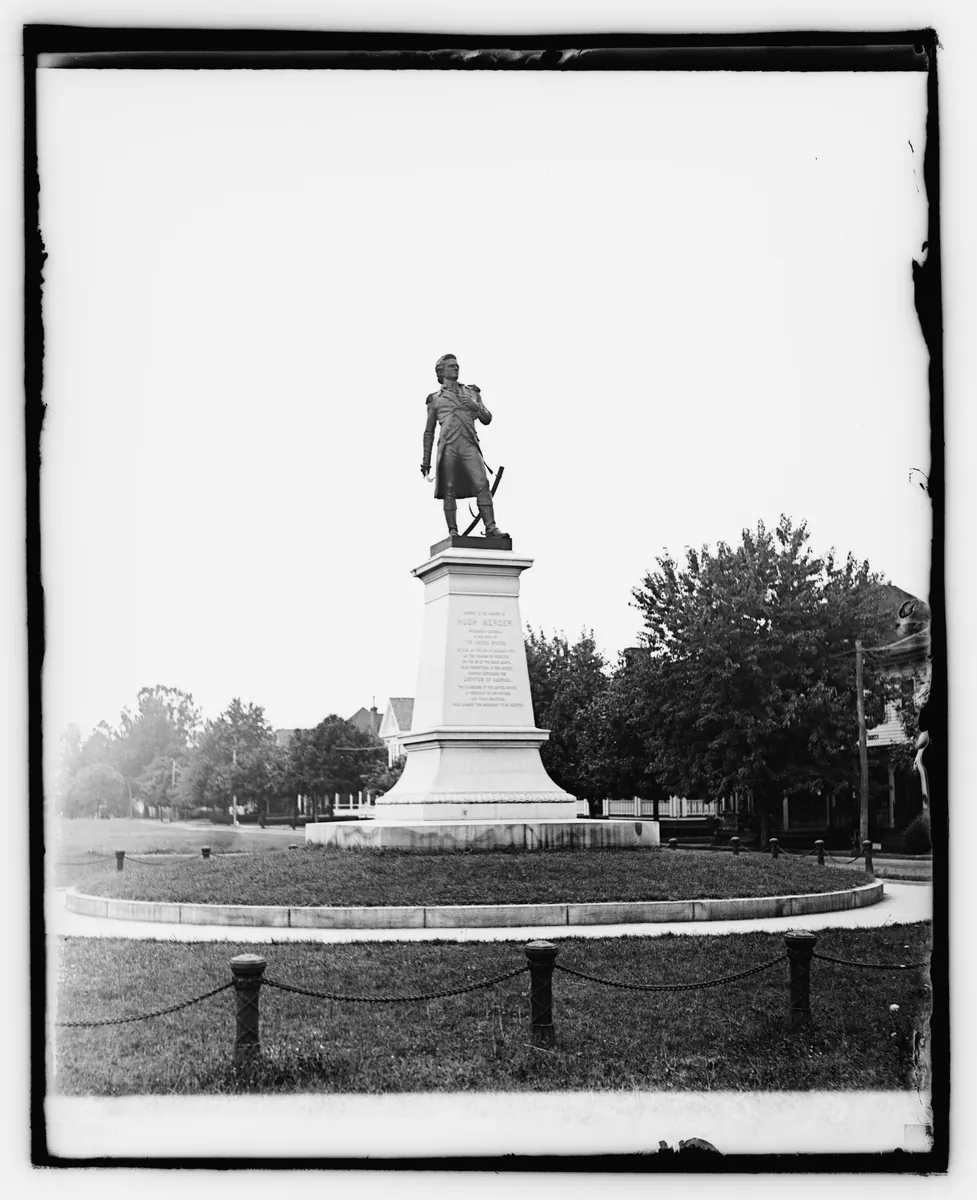
Hugh Mercer came to Fredericksburg in 1760 on George Washington's recommendation to practice medicine after the French and Indian War. He'd studied medicine at the University of Aberdeen, served as an assistant surgeon in Charles Edward Stuart's army, and was present at the Battle of Culloden on April 16, 1746, fled Scotland as a fugitive, and worked for eight years as a physician in Pennsylvania before joining the colonial forces. It was during his military service in the 1750s that he developed a lifelong friendship with Washington. In Fredericksburg he opened an apothecary — the building still stands as a museum — married Isabella Gordon, and became a noted businessman, buying land and trading locally. In 1774 Washington sold him Ferry Farm, the childhood home he'd wanted to turn into a family settlement.
When the Revolution came, Mercer was a member of the Fredericksburg Committee of Safety. As a northern Briton, he was excluded from elected leadership in the new Virginia regiments, but he was appointed colonel of the Minute Men of Spotsylvania, King George, Stafford, and Caroline Counties in 1775. In June 1776 Congress made him a brigadier general. He oversaw construction of Fort Lee, raided British positions on Staten Island, and may have suggested — some accounts credit him — the crossing of the Delaware. At Princeton on January 3, 1777, leading a vanguard of 350, he was surrounded when the British mistook him for Washington. He drew his saber. They beat him down, bayoneted him seven times, and left him to die. Legend says he rested against a white oak — the Mercer Oak, now the seal of Mercer County. He lasted nine days. Washington rallied his men and won the battle. The crisis ended. The French approved arms. Most of the army re-enlisted.
- ·His apothecary is a separate landmark entry. This entry covers the person's life story. Memorial statue of Mercer stands in downtown Fredericksburg.
Memories
Editorial content compiled with AI assistance. Place details verified against public records.