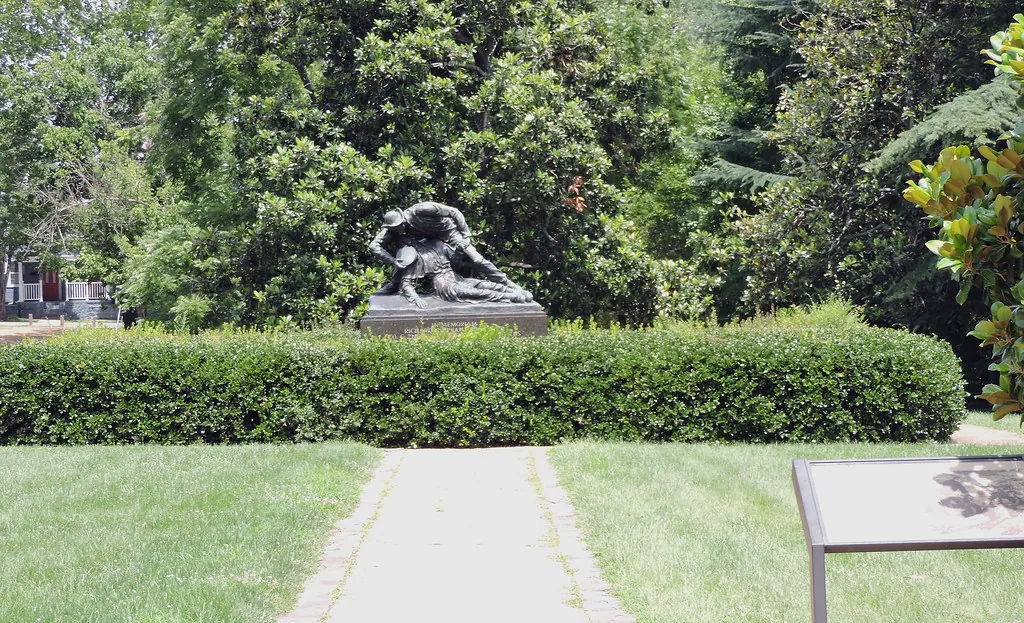
The wounded were on the slope in front of the stone wall at Marye's Heights. Over 8,000 Union soldiers had been shot there during the Battle of Fredericksburg. On the morning of December 14, 1862, many were still alive.
Richard Rowland Kirkland, a sergeant in the 2nd South Carolina, asked his brigade commander for permission to help them. General Joseph B. Kershaw denied the request, then relented. When Kirkland asked if he could carry a white flag, Kershaw said no. Kirkland's answer: "All right, sir, I'll take my chances."
He gathered canteens, filled them with water, and climbed over the wall. He walked onto the field and began giving water, warm clothing, and blankets to wounded Union soldiers. Kershaw later said he watched Kirkland work for more than an hour and a half. Kirkland made multiple trips.
Kirkland was killed at Chickamauga on September 20, 1863. He was twenty years old.
In 1965, sculptor Felix de Weldon — who made the Iwo Jima Memorial — cast a bronze monument showing Kirkland giving water to a wounded Federal soldier. It stands along the Sunken Road, at the stone wall where the act took place. The inscription reads: "At the risk of his life, this American soldier of sublime compassion, brought water to his wounded foes at Fredericksburg."
Fredericksburg was halfway between the capitals of the opposing armies. The battles fought here are among the most studied of the war. This monument is not about strategy or sacrifice in the conventional sense. It's about what one man did when the guns went quiet and the wounded were still there.
- ·Sgt. Richard Rowland Kirkland was born in August 1843 in Flat Rock, Kershaw County, South Carolina, and served in Company E and later Company G of the 2nd South Carolina Volunteer Infantry.
- ·On the morning of December 14, 1862 — the day after the main Battle of Fredericksburg — Kirkland gathered canteens, filled them with water, and ventured onto the exposed battlefield multiple times to give water, warm clothing, and blankets to wounded Union soldiers.
- ·General Joseph B. Kershaw initially denied Kirkland's request to aid the wounded, then relented; Kirkland was forbidden to carry a white flag of truce and responded, 'All right, sir, I'll take my chances.'
- ·General Kershaw observed Kirkland on the battlefield for more than an hour and a half; over 8,000 Union soldiers had been shot at the Marye's Heights stone wall and many remained alive and thirsty.
- ·Kirkland was killed at the Battle of Chickamauga, Georgia, on September 20, 1863, at age 20.
- ·The bronze monument was sculpted by Felix de Weldon — best known for the Iwo Jima Memorial — and unveiled in 1965.
- ·The monument stands along the Sunken Road on the Fredericksburg battlefield, at the site of the stone wall where the act of mercy took place.
Memories
Editorial content compiled with AI assistance. Place details verified against public records.