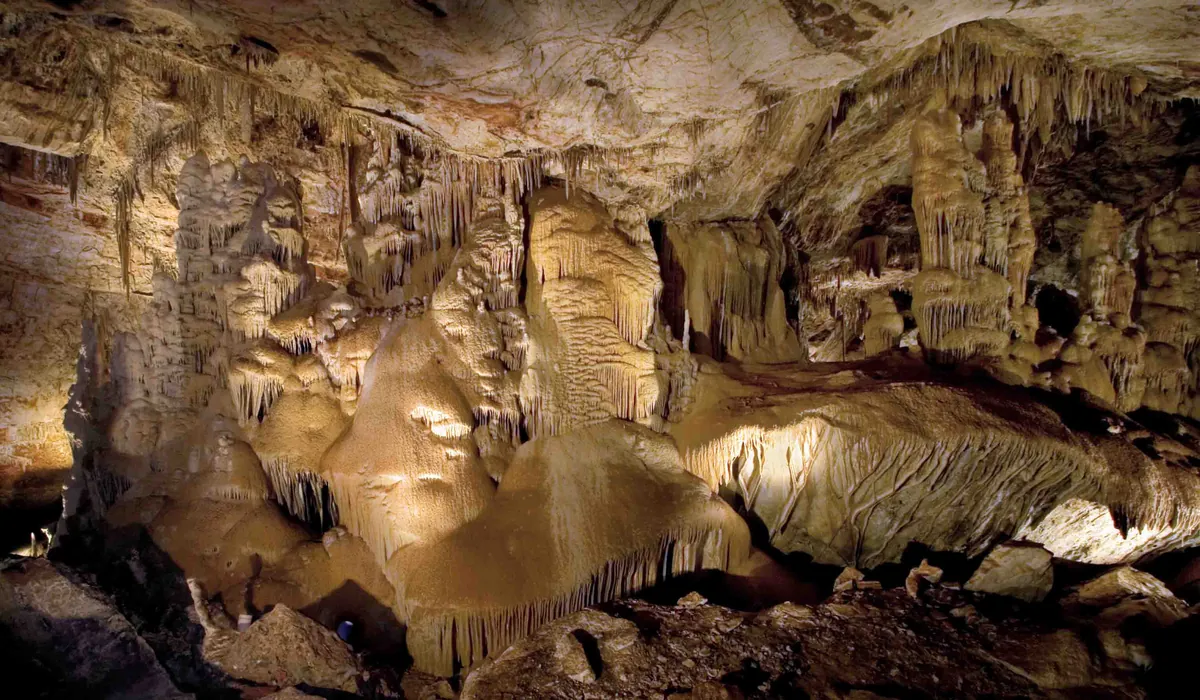
In 1974, two cavers exploring limestone hills near Benson found a cave no one had ever found. Gary Tenen and Randy Tufts kept it secret for fourteen years — until they could be sure it wouldn't be damaged. Unprotected caves get wrecked fast, and what they'd stumbled into was still alive.
They finally told the landowners, who brought in Arizona State Parks. The state spent $28 million on development and opened it to the public in 1999. The engineering keeps the desert out: airlocks, misting systems, humidity controls. Inside, 2.4 miles of passages hold formations still growing after 50,000 years. The Kubla Khan column stands 58 feet tall. The longest soda-straw stalactite measures 21 feet 2 inches — a thread of calcite that hasn't stopped dripping.
The Big Room closes mid-April through mid-October. About 2,000 cave myotis bats roost there each summer to raise their young. When they're gone, the tours resume.
The secret held because the people who found it knew what mattered. Now it's managed the same way — protected first, shown second.
- ·Coords from Wikipedia. KEY FACTS: (1) discovered 1974 by cavers Gary Tenen and Randy Tufts, kept secret until publicly announced 1988; (2) opened to the public 1999 after $28M of development; (3) Kubla Khan column is 58 ft (18 m) tall; longest soda-straw stalactite is 21 ft 2 in (6.45 m); (4) Big Room hosts a ~2,000-bat Myotis velifer nursery roost, so it closes to tours April 15-Oct 15; (5) 2.4 miles of passages, formations still actively growing after 50,000+ years; air-lock doors and misting keep humidity. Near Benson, ~50mi SE of Tucson.
Memories
Editorial content compiled with AI assistance. Place details verified against public records.