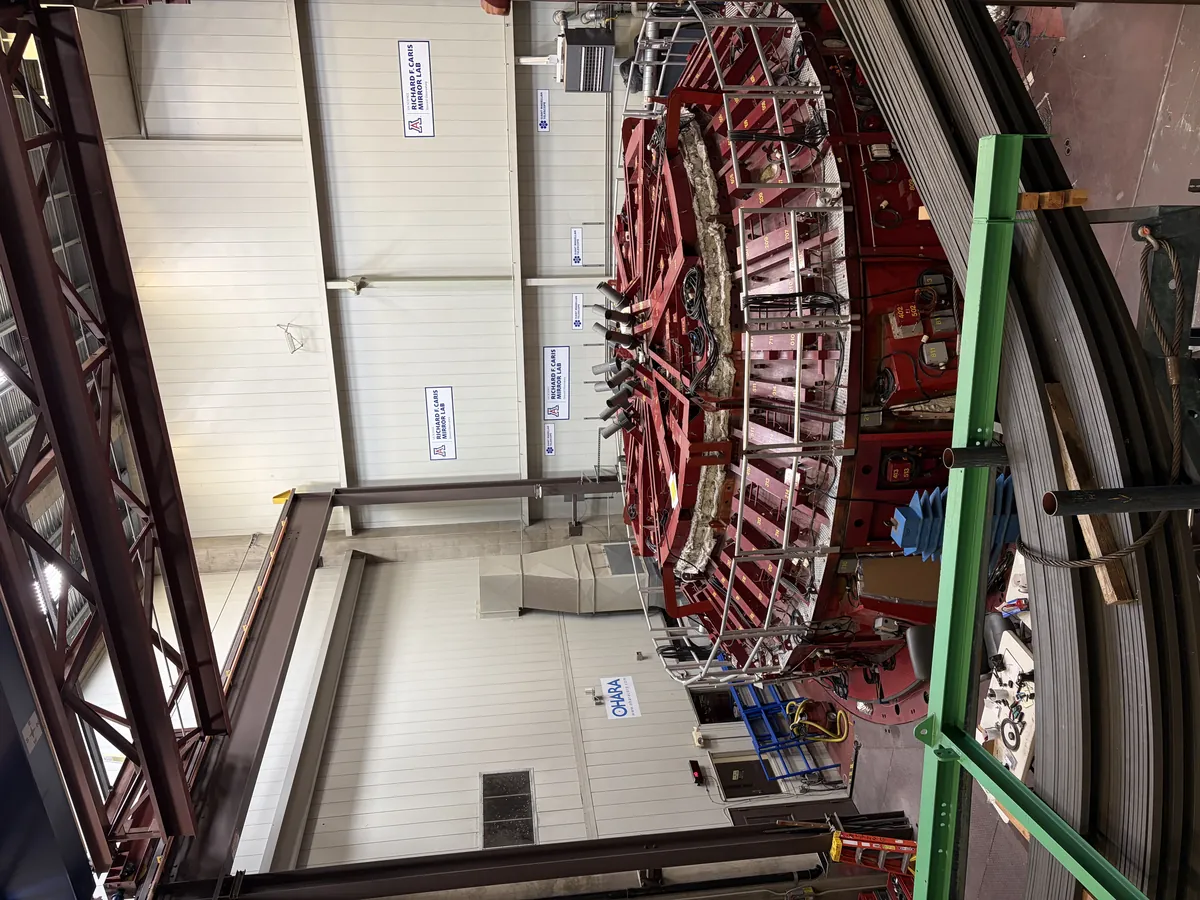
Beneath the football stadium at the University of Arizona, scientists spin-cast the world's largest telescope mirrors. The work began around 1980 with Dr. Roger Angel's backyard experiment — fusing two custard cups in a kiln to test honeycomb casting — and eventually moved under the stadium with funding from USAF, NSF, and the university. What started as a kiln experiment became the Richard F. Caris Mirror Lab, the facility producing mirrors for the telescopes that will peer deepest into the universe.
The mirrors have a honeycomb structure inside, made from Ohara E-6 low-expansion glass melted into that form while a custom rotating furnace spins. The spin casting shapes the curve as the glass cools. Honeycomb construction gives these mirrors the rigidity and stability of solid glass while allowing them to be dramatically larger and lighter. Mirrors cast here have gone into the Magellan telescopes and the Large Binocular Telescope. Seven primary segments are under construction for the Giant Magellan Telescope — a 25-meter instrument that will probe the early universe, the formation of the first stars, and potentially signs of life on distant exoplanets, all in optical and infrared light.
Tours run about 90 minutes. You begin at Steward Observatory on Cherry Avenue, then walk to the lab for an up-close look at the casting, polishing, and optical testing in progress. This is a working floor, not a museum — the mirrors being finished today will gather starlight long after the team that cast them has retired. If you want to see where Tucson's scientific tradition meets the outer edge of what's technically possible, this is the room.
- ·Work began ~1980 with Dr. Roger Angel's backyard experiment fusing two custard cups in a kiln to test borosilicate honeycomb casting; moved under the football stadium by 1985 (USAF/NSF/UA funding). Pioneered rotating-furnace spin casting. Tours available. Coords = stadium (approximate). K-10: 4+ facts. Genuinely unique -- mirrors here go into the world's largest telescopes.
Memories
Editorial content compiled with AI assistance. Place details verified against public records.