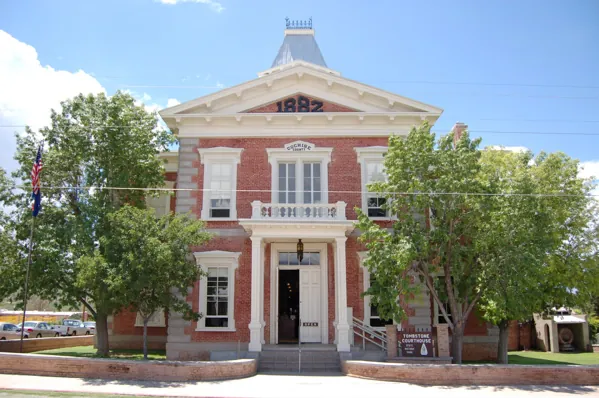
The Cochise County courthouse went up in Tombstone in 1882, a two-story red-brick building laid out in a cruciform plan, at a cost of $50,000. Victorian by style, territorial by circumstance — when silver miners flooded southeastern Arizona after Ed Schieffelin's 1877 strike, the boomtown exploded to 7,000 people, all of them making the 150-mile round trip to Tucson to file claims and deeds at the Pima County seat. In 1881 the legislature carved out Cochise County and gave Tombstone the courthouse. The ground floor held the sheriff, recorder, treasurer, and Board of Supervisors; upstairs ran the courtrooms; in back sat the jail. A rear addition came in 1904.
The county seat moved to Bisbee in 1929 and the last office vacated in 1931. The building stood empty through the 1940s hotel attempt and into the 1950s until the Tombstone Restoration Commission took it over in 1955. It became Arizona's first state park to open in 1959, now a museum of Tombstone and Cochise County history. In the courtyard stands a replica gallows marking the spot where seven men were hanged. Listed on the National Register April 13, 1972.
- ·Coords from Wikipedia. KEY FACTS: (1) built 1882, two-story red-brick cruciform plan, cost $50,000; (2) Territorial Victorian style; rear addition 1904; (3) housed sheriff, recorder, treasurer, supervisors, courtrooms, and jail; served as county courthouse until 1929 (seat moved to Bisbee); (4) NRHP listed April 13, 1972 (ref 72000196); (5) became part of Arizona State Parks in 1959 — first state park to open; replica gallows in courtyard marks where 7 men were hanged. 40,105 visitors in 2022.
Memories
Editorial content compiled with AI assistance. Place details verified against public records.