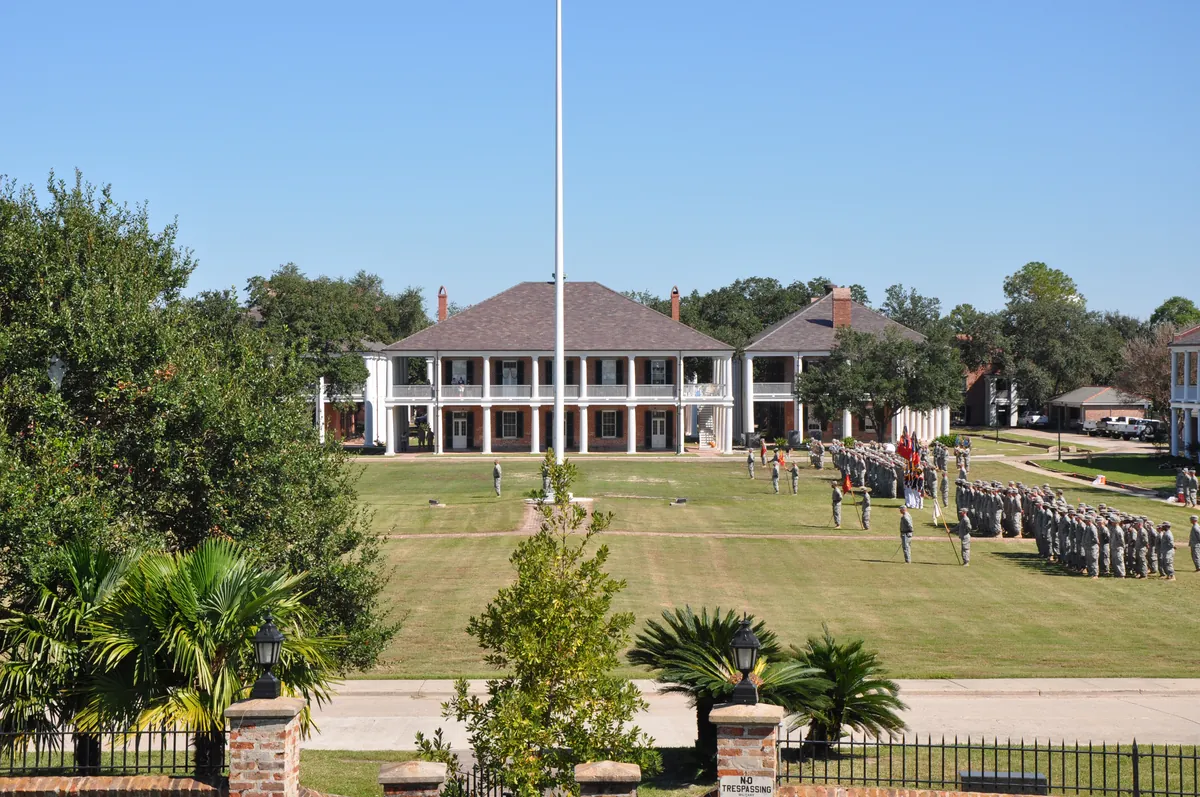
The quadrangle Lieutenant Frederick Wilkinson designed in the 1830s was built to be a rallying point under attack — the backs of the buildings have no outward-facing windows, acting as fortification walls joined by a ten-foot brick facade. The first troops occupied the barracks by February 1837. Within two decades, a roster of junior officers who would tear the country in half had all served here: Ulysses S. Grant, Robert E. Lee, George B. McClellan, J.E.B. Stuart, P.G.T. Beauregard. Not at the same time, but all here, on the same parade ground, before the war made them strangers.
New Orleans was the largest port in the South, exporting most of the nation's cotton to Europe and New England. Jackson Barracks — originally called New Orleans Barracks when established in 1834 — was positioned to support the chain of coastal forts Congress authorized after the War of 1812. During the Mexican-American War, it became a mustering station for troops shipping out. The wounded coming back from Mexico initiated construction of a federally operated hospital in 1849 — the first Public Service Hospital for Veterans in the country.
In 1861, Confederate forces took control. Federal forces recaptured it in 1862. On July 7, 1866, the post was renamed after Andrew Jackson, who won the Battle of New Orleans. The 25th Infantry Regiment — the Buffalo Soldiers — was headquartered here under Colonel Joseph A. Mower until May 1870.
The Mississippi River moved closer over the years. In 1912, it breached the levee, destroying the road, railroad, and trolley tracks. The executive office building and the front two guard towers were dismantled to make room for a new levee. During the Great Depression, Governor Huey P. Long used Works Progress Administration personnel to extensively renovate the barracks, including construction of Fleming Hall.
On August 29, 2005, Hurricane Katrina's storm surge breached the Industrial Canal levee and submerged parts of Jackson Barracks with more than 20 feet of water. The tidal surge virtually destroyed the entire complex. Secretary of the Army Francis J. Harvey, after touring the wreckage, noted that Jackson Barracks is "a very important piece of American history that needs to be preserved." Congress authorized 100 percent of the funding for reconstruction — $325 million in total. The 1837 Old Powder Magazine and 14 antebellum homes in the original garrison received a $35 million restoration from FEMA.
In 2013, the Ansel M. Stroud, Jr. Military History and Weapons Museum reopened in a new multi-use complex with exhibits covering the Louisiana Guard response to Katrina, the Global War on Terror, and the Gulf War of 1990-1991. The museum is at 6400 St. Claude Ave. Hours vary — call ahead. Admission is free.
- ·Built in 1835 as a federal military post on the Mississippi River.
- ·Robert E. Lee, Ulysses S. Grant, and P.G.T. Beauregard all served here before the Civil War split them into opposing armies.
- ·One of the most intact antebellum military installations in the country — the original brick quadrangle still stands.
- ·Served as Louisiana National Guard headquarters until Katrina flooded the complex; restoration took over a decade.
- ·The military museum on the grounds traces Louisiana's role in every American conflict from 1812 to the Gulf War.
- ·Located at 6400 St. Claude Ave. Museum hours vary — call ahead. Free admission.
Memories
Editorial content compiled with AI assistance. Place details verified against public records.