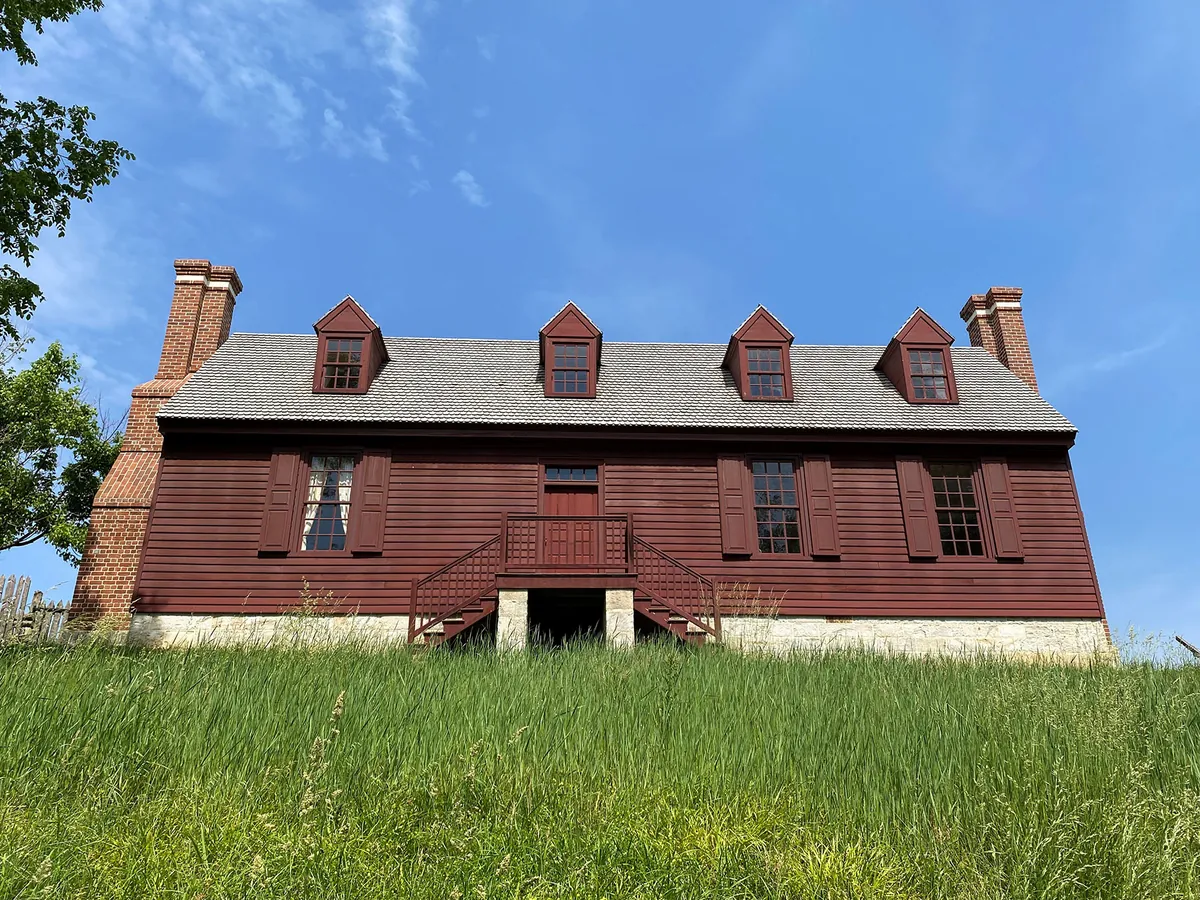
Washington spent his childhood at a farm on the Rappahannock's north bank, across from Fredericksburg, but the place wasn't called Ferry Farm then. The family called it the Home Farm. The name Ferry Farm came later—borrowed from a free ferry that crossed the river on Washington land, though the Washingtons never owned or operated it.
His father Augustine bought the property in 1738 and built a house: a story-and-a-half central-passage structure, two rooms deep, roughly 54 feet wide by 28 feet deep. George was six when the family moved in. He lived there until his early twenties, but he was not sentimental about it. Washington saw the farm as "a crowded, busy, trouble-filled place of limited options."
At sixteen, he used his father's surveying instruments to survey for prominent Virginia grandees. Surveying linked him to his half-brother Lawrence and the Fairfaxes. By eighteen, Lord Fairfax had granted him a 453-acre tract in western Frederick County. Washington surveyed it, purchased adjoining land, and within three years had acquired close to two thousand acres through his own work—more than Ferry Farm would be worth. He often stayed at Mount Vernon with Lawrence instead.
His mother lived in the house until 1772, when the farm was sold to Hugh Mercer. The house was in ruins by 1833.
Parson Weems's Life of Washington told a story in which six-year-old George barked his father's favorite English cherry tree with a new hatchet and confessed: "I cannot tell a lie; I did it with my little hatchet." It's also said Washington threw a silver dollar across the Rappahannock from here. Each year during Washington's birthday celebration, townspeople attempt the throw. In 2006, an archaeology intern duplicated it—and did it again the following summer to prove the first throw was not a fluke.
Archaeologists working the site since 2002 announced in July 2008 they had found remains of the boyhood home, which had suffered a fire in 1740. Among the artifacts: pieces of a cream-colored tea set probably belonging to Mary Ball Washington. In 2015, the George Washington Foundation began constructing a replica above the original foundations using eighteenth-century building techniques, contemporary descriptions, and knowledge of similar colonial Virginia houses. The replica opened in 2018, stocked with reproductions of furniture listed in Augustine Washington's probate inventory from 1743. Tour guides encourage visitors to interact with the objects—sit on the furniture, open cabinets, handle things.
During the Civil War, Union soldiers occupied the farm as a campground. President Lincoln toured Ferry Farm in 1862, familiar with Weems's myths. Soldiers who knew the cherry tree story carved trinkets from a tree they believed to be the one.
In 1995, Walmart sought to purchase the land, promising a columned plaza with "special tributes to George and the Cherry Tree." Fredericksburg small business owners, local preservationists, and national organizations including the Daughters of the American Revolution opposed the sale. A review board rejected Walmart's offer on April 1, 1995. The George Washington Foundation purchased the land in 1996.
Excavations have uncovered artifacts spanning millennia—a spear point made over 10,000 years ago, tools from hunter-gatherers, pottery from native farmers, Civil War relics. The site became a National Historic Landmark in 2000. The replica house stands at 237 King's Highway, near Fredericksburg.
- ·The famous 'coin across the river' legend — young Washington throwing a silver dollar or stone across the water — is set at the Rappahannock, not the Potomac. The Potomac is ~50 miles north; the Rappahannock runs directly past Ferry Farm. George Washington spent his formative years here (ages 6-22). Ferry Farm was also Washington's base of operations early in his surveying career. Active archaeology by the George Washington Foundation has recovered thousands of artifacts including ceramics, tools, and structural remains from the Washington-era house.
Memories
Editorial content compiled with AI assistance. Place details verified against public records.