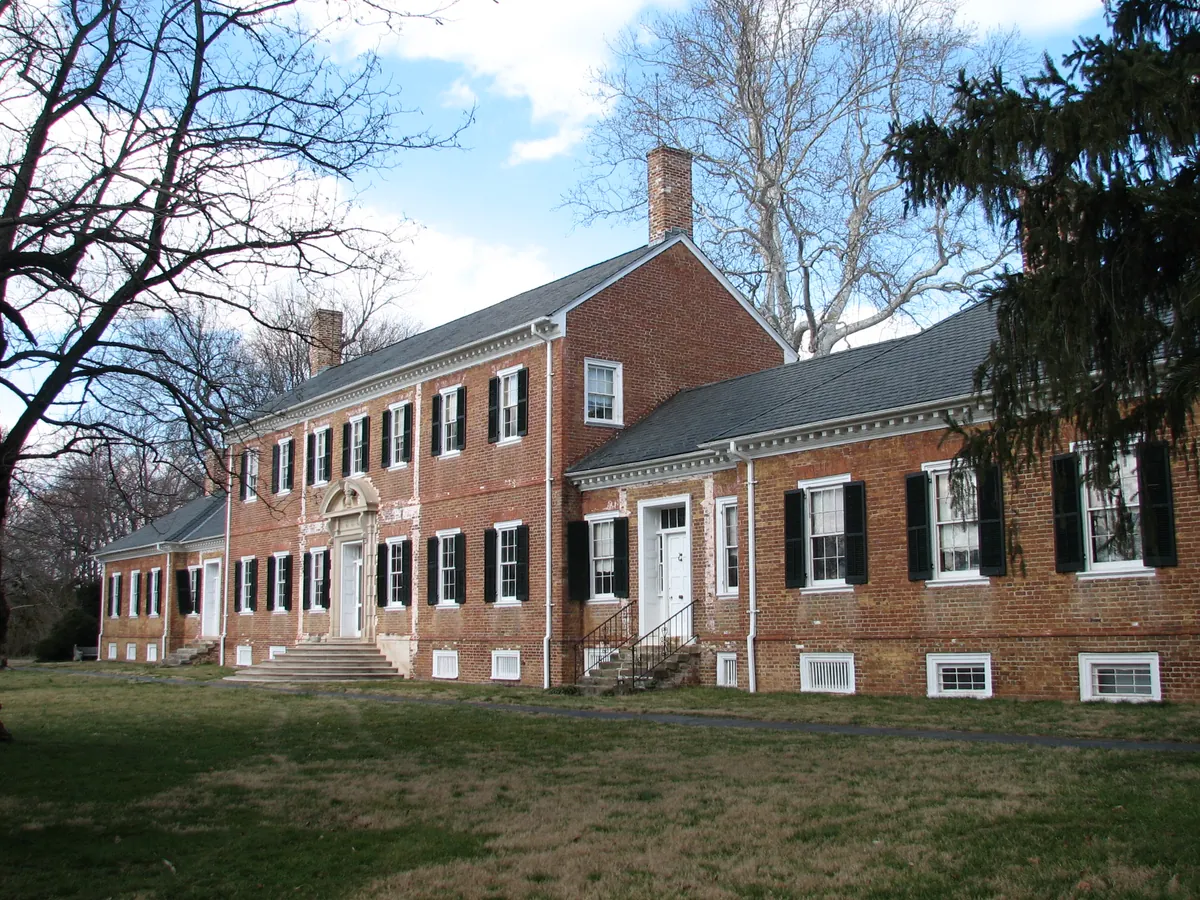
The Georgian mansion on the Rappahannock's western bluff took three years and an enslaved workforce to complete, finished in 1771. William Fitzhugh built it — wealthy lawyer, planter, friend of George Washington. He named it for William Pitt, 1st Earl of Chatham, the British parliamentarian who had championed colonial opinions before the Revolution. The house exhibits its architectural highlights on the riverside facade, the side meant to be seen from Fredericksburg across the water. Washington, whose family's farm lay downriver, visited often; his diaries note the frequency. The two had served together in the House of Burgesses and shared a love of farming and horses.
Fitzhugh owned upward of 100 enslaved people and about 49,000 acres. The 1,280-acre plantation at Chatham included an orchard, mill, and race track where his horses competed for prize money. In January 1805, Chatham's enslaved people overpowered and whipped their overseer and assistants who tried to force them back to work at what they considered was too soon after the Christmas holidays. An armed posse put down the rebellion. One enslaved man was executed, two died trying to escape, and two others were deported — perhaps to the Caribbean or Louisiana. Fitzhugh sold the property soon after.
Half a century later, owner Hannah Jones Coalter died in 1857 and attempted to free her 93 enslaved people. She gave each (except her administrator Charles, freed outright) the choice of manumission with money to establish themselves in another state or country, or passage to Liberia, or remaining enslaved in Virginia with any of her family members they might choose. Her relatives sued. The Virginia Supreme Court, in a 3-to-2 decision, invoked the Dred Scott ruling — enslaved people were property, incapable of choice. The executors sold Chatham with its enslaved people to J. Horace Lacy for $35,000.
Ellen Mitchell, an enslaved laundress who had counted on Coalter's promise, protested loudly. Lacy sold her to a slave trader, James Aler, in Fredericksburg. Aler, active in his church and unsure what to do with Mitchell, allowed her a 90-day pass to travel and raise money for her freedom. In early 1860 she gave speeches in Washington, Baltimore, Philadelphia, New York, and Boston, raising enough to buy freedom for herself and her children. She returned to Fredericksburg, purchased her freedom, and Lacy, impressed, also freed her mother. The family moved to Cincinnati.
When the Civil War came, Lacy left to serve the Confederacy. His wife and children fled Chatham in spring 1862 as Union troops arrived. For thirteen months the Federal army occupied the house — referred to in orders and reports as the "Lacy House." General Irvin McDowell brought 30,000 men to Fredericksburg in April 1862 and supervised repair and construction work from Chatham. Northern officers used the mansion as headquarters. President Abraham Lincoln traveled to Fredericksburg to confer with McDowell, meeting with the general and his staff at Chatham. Lincoln's visit gave the house the distinction of being one of three residences visited by both Washington and Lincoln — the others are Mount Vernon and Berkeley Plantation on the James River.
General Ambrose Burnside brought 120,000 men to Fredericksburg in November 1862. The Battle of Fredericksburg became a disastrous Union defeat — Burnside suffered 12,600 casualties. For several days, army surgeons operated on hundreds of soldiers inside Chatham. Assisting them were Walt Whitman, Clara Barton, and Dr. Mary Edwards Walker. Whitman had come searching for a wounded brother. Outside the house, at the foot of a tree, he noticed "a heap of amputated feet, legs, arms, hands, etc.—about a load for a one-horse cart." More than 130 Union soldiers died at Chatham and were initially buried on the grounds. Count Zeppelin, a German military observer, sent up a reconnaissance balloon with a soldier from Chatham's lawn to observe the battle — an incident he later recounted after starting his aircraft factory.
By war's end, Chatham was desolate. Over 750 panes of glass had been broken, blood stains spotted the floors, graffiti marred the bare plaster walls, and much of the interior wood paneling had been removed for firewood. The surrounding forests had been cut down, and the lawn had been used as a graveyard. The Lacys, unable to maintain the house without enslaved labor, sold it in 1872 to a Pennsylvania banker for $23,900.
General Daniel Bradford Devore and his wife Helen undertook restoration in the 1920s, adding a large walled English-style garden designed by landscape architect Ellen Biddle Shipman. John Lee Pratt, a General Motors executive, purchased Chatham in 1931 for $150,000 cash. During World War II, he served as one of President Roosevelt's "dollar-a-year" men and hosted Generals George Marshall and Dwight Eisenhower at Chatham for duck hunting and respite from Washington. Upon Pratt's death in 1975, he bequeathed the manor house and approximately 30 acres to the National Park Service. It now serves as headquarters for the Fredericksburg and Spotsylvania National Military Park. Five rooms are open as a museum during designated hours; the grounds are open to the public. Some of the Union soldiers' pencil graffiti is still visible on the exposed plaster walls.
- ·Located in Stafford County on the north bank, directly opposite Fredericksburg. Now NPS headquarters for FRSP. Coordinates: 38°18′31.8″N 77°27′19.3″W.
Memories
Editorial content compiled with AI assistance. Place details verified against public records.