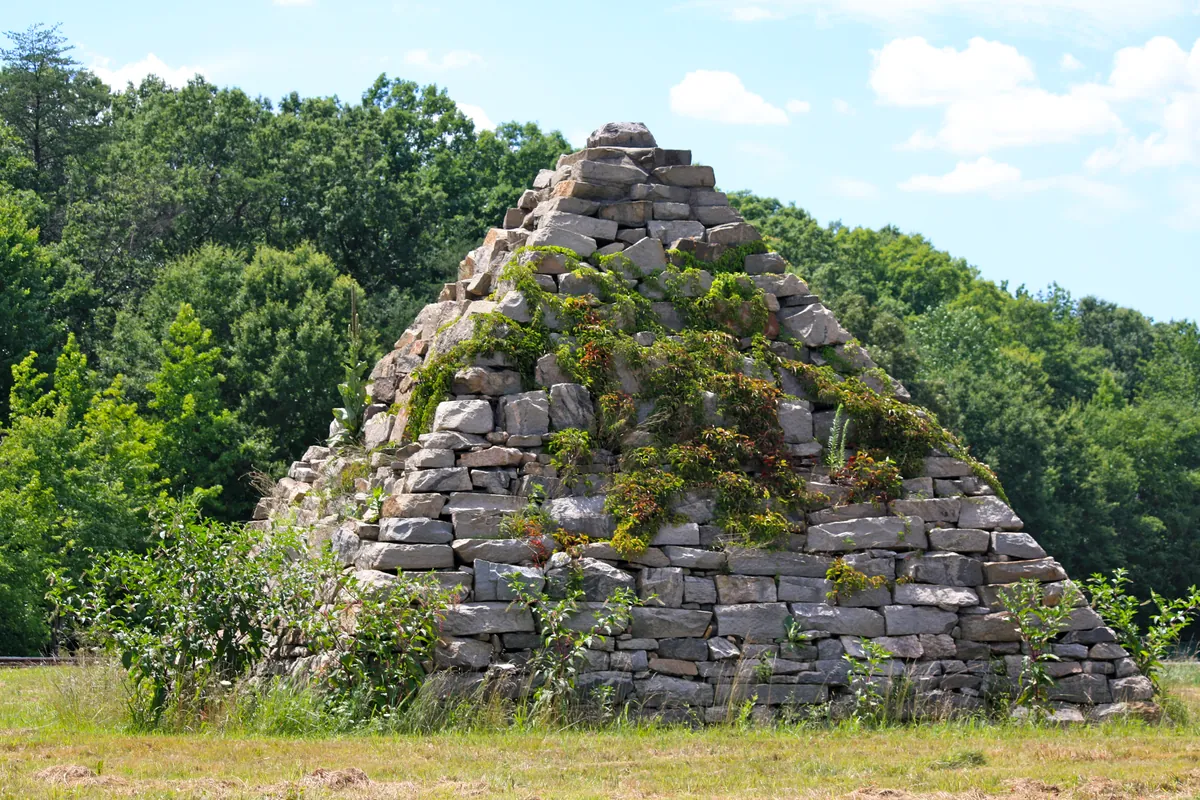
A rough-hewn granite pyramid stands 23 feet tall on a 30-square-foot base beside the railroad tracks where Maj. Gen. George G. Meade's Pennsylvania Reserve division punched through the only gap in Stonewall Jackson's Confederate line on December 13, 1862. It was the single Union breakthrough that day. Meade's troops found themselves alone — no support followed — and were forced back. His 3rd Division lost more than 40 percent of its strength: 1,853 men killed, wounded, missing, or captured.
The monument went up in 1898, but not by the victors. The Confederate Memorial Literary Society built it after approaching Virginia railroad executives in 1897 with a proposal to mark significant Civil War sites along their lines. The executives agreed, and the society erected a stone pyramid modeled after the memorial to unknown Confederate dead at Hollywood Cemetery in Richmond. A memorial to Union courage, erected by Confederate hands, marking the place where the line broke but the battle was already lost.
- ·The Meade Pyramid is a rough-hewn granite pyramid standing 23 feet tall with a 30-square-foot base, erected in 1898.
- ·Despite marking a Union military achievement, the pyramid was built by the Confederate Memorial Literary Society, modeled after the memorial to unknown Confederate dead at Hollywood Cemetery in Richmond.
- ·The pyramid marks where Maj. Gen. George G. Meade's Pennsylvania Reserve division penetrated a boggy gap in 'Stonewall' Jackson's Confederate lines on December 13, 1862 — the only Union force to break through that day.
- ·After breaching the Confederate line, Meade's troops were unsupported and forced to withdraw; his 3rd Division suffered more than 40 percent casualties, with 1,853 soldiers killed, wounded, missing, or captured.
- ·The Confederate Memorial Literary Society initiated the monument in 1897 after contacting Virginia railroad executives to erect markers at historically significant sites along their rail lines.
Memories
Editorial content compiled with AI assistance. Place details verified against public records.