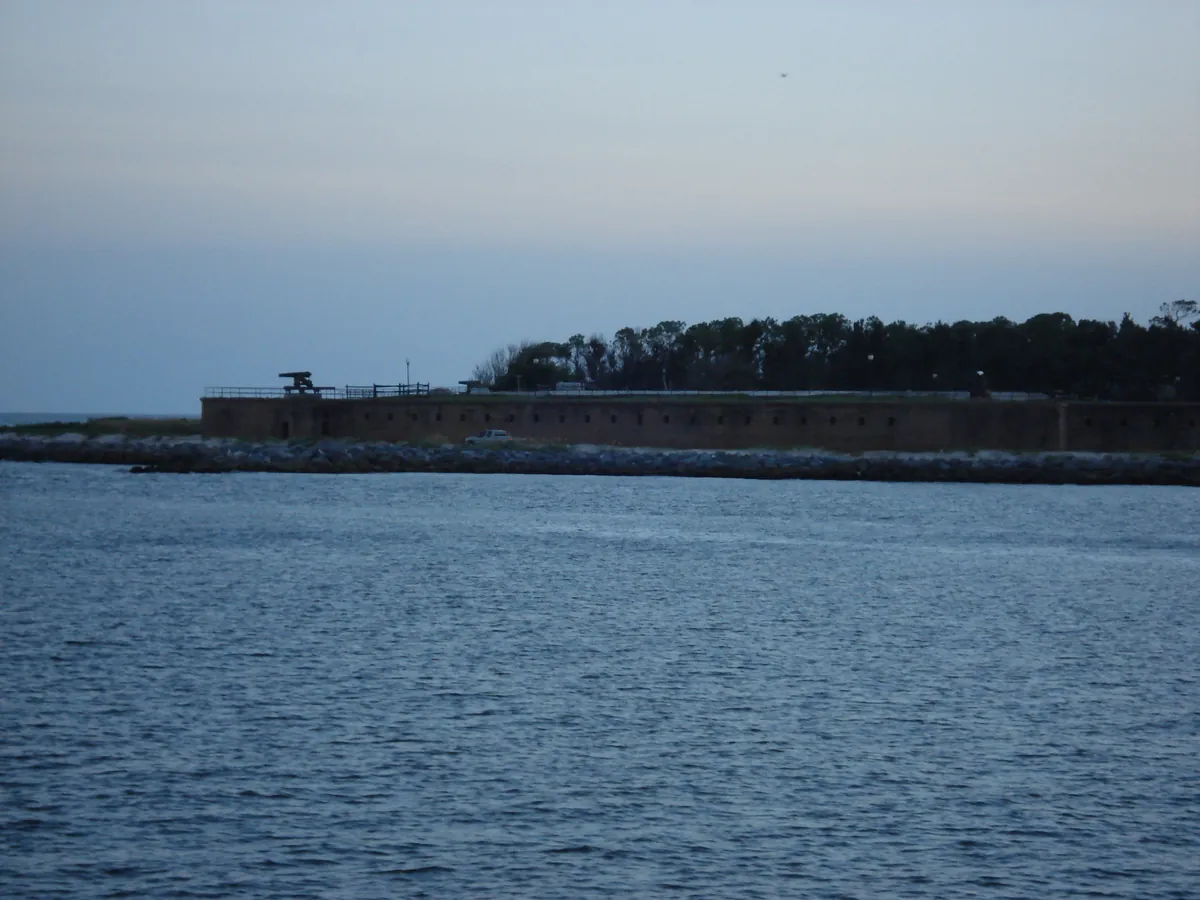
The pentagonal masonry fort at Dauphin Island's eastern tip was established in 1821, named for Edmund Pendleton Gaines. It's best known for its role in the Battle of Mobile Bay during the Civil War — the engagement that produced Admiral David Farragut's command from USS Hartford's deck: "Damn the torpedoes – full speed ahead!"
Hartford's anchor sits here now, huge and iron. So do the original cannons used in the battle, five pre-Civil War brick buildings in the interior courtyard, tunnel systems leading to the corner bastions, and working blacksmith shop and kitchens. A museum covers the period, plus the French colonial presence that began in the late 17th century. The destination context runs deeper than the fort: d'Iberville established a port for Fort Louis de La Louisiane on this island, drawn by abundant timber, reliable fresh water, and a deep-water harbor. The island served as a major trading depot where goods from Saint-Domingue, Mexico, Cuba, and France were unloaded. Before a channel was dredged, Mobile Bay was too shallow and its sandbars too treacherous for ocean-going vessels — smaller boats carried cargo within the bay to and from Dauphin Island. Fort Gaines was partially modernized for the Spanish–American War.
The fort is listed on the National Register and has been nominated for National Historic Landmark status. It's considered one of the nation's best-preserved Civil War era masonry forts. It's also eroding into the Gulf. The fort sits feet from the water on the island's east end, losing up to ten feet of beach and dune per year. Hurricanes have cracked the masonry repeatedly — damage largely repaired, but the Gulf keeps coming. In 2009 the Civil War Preservation Trust named it one of the ten most endangered Civil War battlefields in the United States. In 2011 the National Trust for Historic Preservation added it to America's eleven most endangered historic places.
Tours run. Reenactments happen. You can walk the tunnels and stand where the guns were. The reason to go is to see what brick and iron look like when they've held a position for two centuries and the sea wants it back.
- ·Named for Brig. Gen. Edmund Pendleton Gaines (War of 1812). Original casemates, tunnel network, cannon emplacements, blacksmith shop, museum open to visitors. Ferry landing is at fort's eastern tip. One of the best-preserved 19th-century coastal forts in the country. Fort surrendered August 8, not August 5 (the naval battle day). NRHP 1976.
Memories
Editorial content compiled with AI assistance. Place details verified against public records.