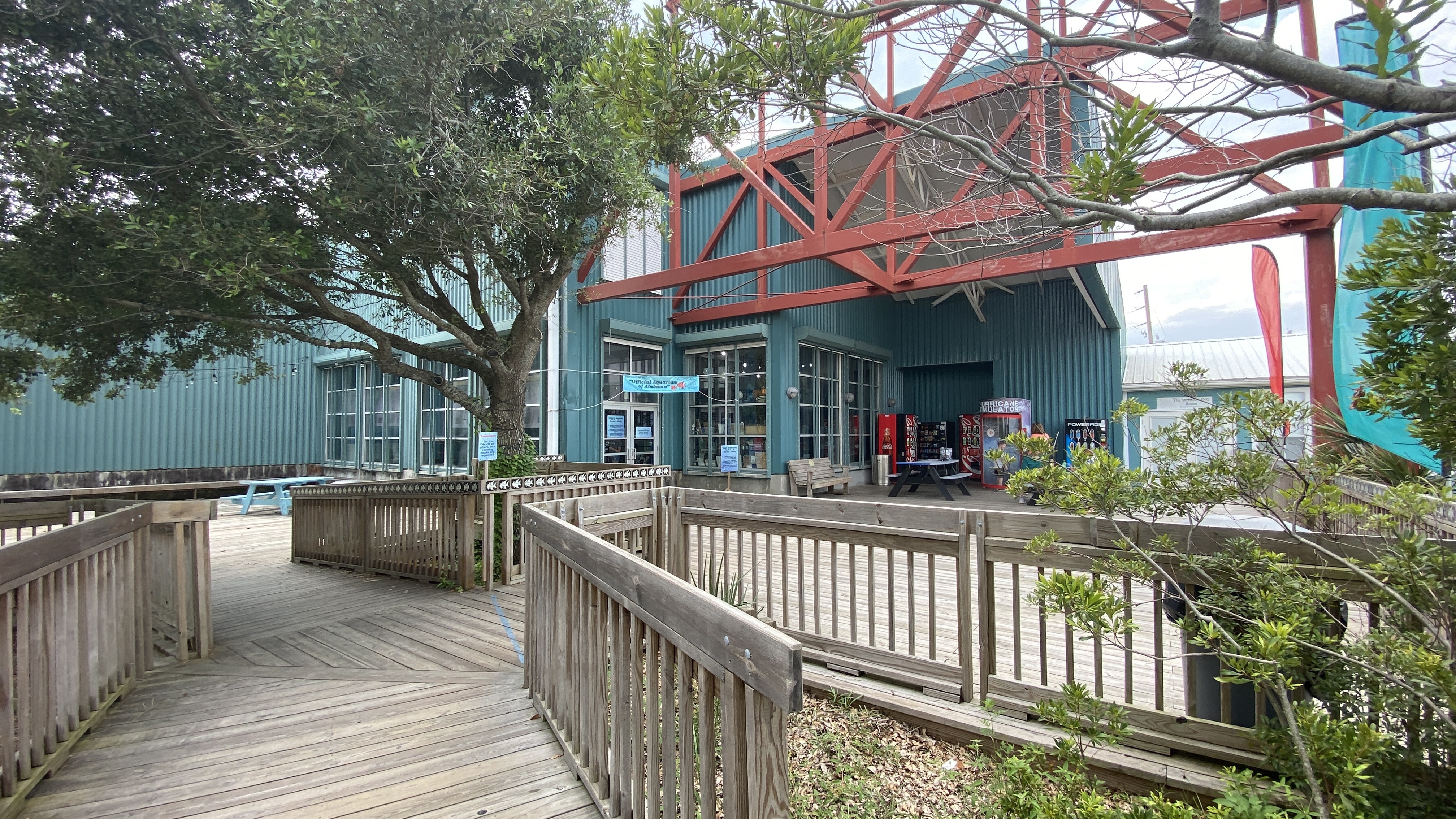
The Dauphin Island Sea Lab stands on a barrier island that once greeted migrating birds and ocean-going French ships with equal hospitality — and now does it again, only this time the ships are research vessels and the migrants include marine scientists. The facilities occupy an old Air Force radar station next to Fort Gaines, and what was radar country in the Cold War became Alabama's primary marine research center when the state legislature established it in 1971.
The public face of the operation is the George F. Crozier Estuarium, a 10,000-square-foot exhibit hall that walks visitors through four linked ecosystems in the order the water connects them: the Mobile-Tensaw River Delta, Mobile Bay, the barrier islands, and the open Northern Gulf of Mexico. The first gallery recreates Alabama's largest wetland with multi-species displays of American alligator, turtles, and gar. The second features a replica of the legs of the Middle Bay Lighthouse and houses brackish-water species — stone crabs, horseshoe crabs, blue crabs, oysters, spadefish, flounder. The third shows saltwater species common to Alabama's barrier islands. The fourth runs deeper: octopus, lobsters, eels, seahorses, red snapper, sharks, jellyfish.
In March 2013 the Estuarium added Rays of the Bay, a 6,400-gallon touch tank holding six sets of four ray and skate species indigenous to the Northern Gulf of Mexico and Mobile Bay — Southern stingray, Cownose ray, Atlantic stingray among them. It's one of the few places on the Alabama coast where you can put your hand on the animal instead of just looking at it through glass.
The Alabama Marine Mammal Stranding Network took residence in a new 2,300-square-foot facility here on May 22, 2015, dedicated to studying dolphin, manatee, and whale strandings along the Alabama Gulf Coast. The work is what it sounds like: when something washes up, they respond. The aquarium is the public program; the stranding network is the emergency room. Both belong to the same institution, which is how marine science actually operates — education and crisis response under one roof, on an island that's been receiving what the Gulf sends ashore since the Mississippian mound builders were here 1,500 years ago.
- ·Origins: Drs. Bishop and Chermock began UA student field trips here 1960; UA bond 1963 funded first lab. Living marsh boardwalk + Windows to the Sea exhibit (2017). 40-acre research campus, ~12,000 sq ft public exhibits.
Memories
Editorial content compiled with AI assistance. Place details verified against public records.