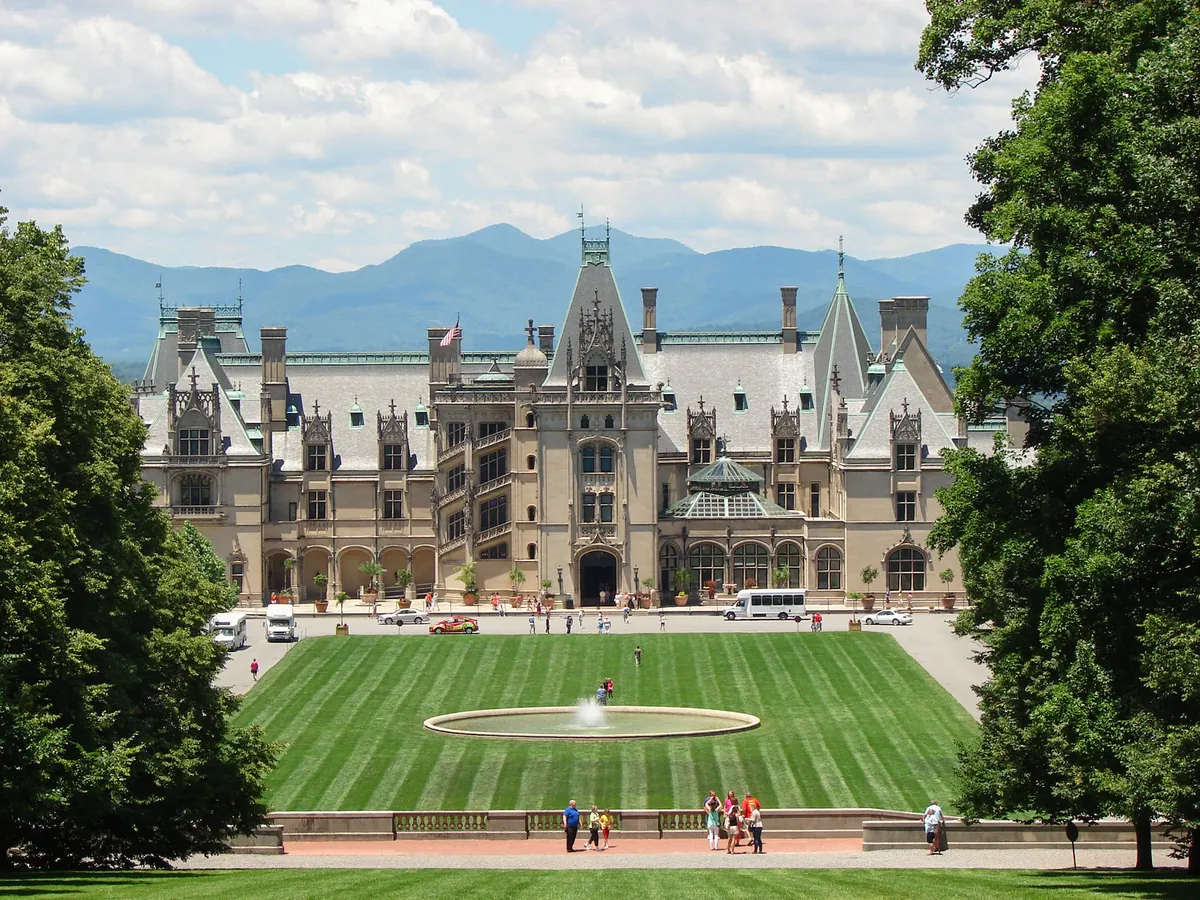
George Vanderbilt opened the largest privately owned house in the United States on Christmas Eve 1895. He had spent six years building it — 178,926 square feet across 250 rooms on 125,000 acres assembled parcel by parcel near Asheville. Construction required a thousand workers, sixty stonemasons, a woodworking factory and brick kiln built on site, and a three-mile railroad spur to haul materials. The house cost five million dollars. Vanderbilt made trips to Europe during the build to purchase tapestries, carpets, prints dating from the 15th century forward.
Richard Morris Hunt designed the house in the Châteauesque style, drawing on French Renaissance châteaux Vanderbilt and Hunt had visited in 1889: Blois, Chenonceau, Chambord, England's Waddesdon Manor. The four-story Indiana limestone facade faces east, 375 feet wide. Sixteen chimneys punctuate the steeply pitched roof, each slate tile drilled at the corners and wired onto the attic's steel infrastructure. Rafael Guastavino, a Spanish architect and engineer, personally supervised installation of the self-supporting ceramic tile vault and arch system he had patented, used extensively inside and outside.
The house had electricity from the time it was built — direct current, a result of Vanderbilt's friendship with Thomas Edison. An electric Otis elevator, forced-air heating, centrally controlled clocks. Thirty-five bedrooms for family and guests, forty-three bathrooms, sixty-five fireplaces, three kitchens. The basement held a 70,000-gallon heated swimming pool with underwater lighting. The Banquet Hall measures 42 by 72 feet with a 70-foot barrel-vaulted ceiling; the table seats sixty-four beneath rare Flemish tapestries. The two-story Library contains over 10,000 volumes in eight languages.
Frederick Law Olmsted designed the grounds. Gifford Pinchot and later Carl Schenck managed the forests; Schenck established the first forestry education program in the United States here in 1898. During World War II, sixty-two paintings and seventeen sculptures — including the Gilbert Stuart portrait of George Washington and works by Rembrandt, Raphael, and van Dyck — were moved from the National Gallery by train for safekeeping.
The estate draws 1.4 million visitors a year. The house is still owned by Vanderbilt's descendants.
- ·One Lodge Street, Asheville. Birthplace of American forestry (see Cradle of Forestry candidate). NHL designation rare in NC. Antler Hill Village/Winery adjacent. Architect Richard Sharp Smith was supervising architect on site.
Memories
Editorial content compiled with AI assistance. Place details verified against public records.