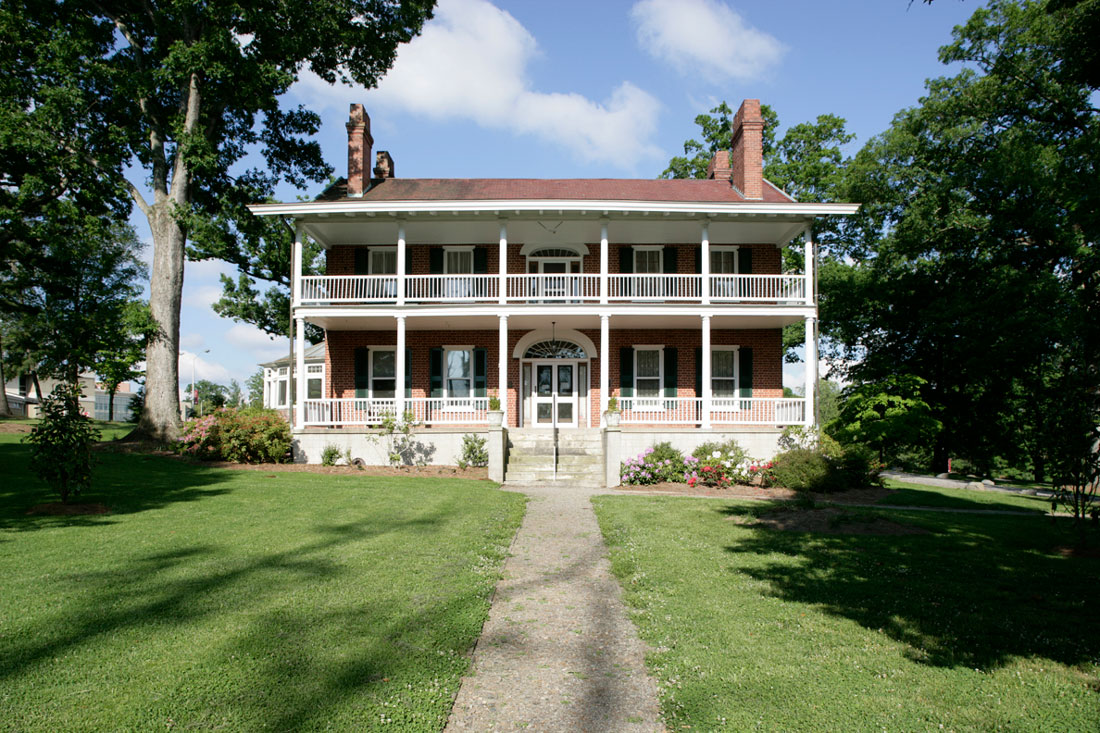
The oldest brick house still standing in Buncombe County sits at the confluence of the French Broad and Swannanoa rivers—where two Indian trails once crossed, where the Cherokee called the meeting ground Untokiasdiyi, "where they race." James McConnell Smith, Asheville's second mayor and one of the region's wealthiest enslavers, built it around 1840 on land his father, a Revolutionary War veteran, had bought for a hundred dollars in 1796. Brick was a statement—almost no one in antebellum western North Carolina could afford it. The people Smith held captive, at least seventy of them, likely built the house that proved his reach.
Smith ran toll bridges, hotels, mills, a tannery. When he died in 1856, his son inherited the estate and thirteen enslaved people; when the son died three years later without a will, his sister Sarah and her husband, Confederate Major William Wallace McDowell, bought the house at auction for ten thousand dollars. They added more enslaved labor—eventually around forty people—and raised eight children there until post-war ruin forced a sale in 1880.
The house changed hands through the decades. One owner brought in Frederick Law Olmsted Jr. to design the grounds. Another hired Richard Sharp Smith, who'd overseen work at Biltmore, to redo the interiors—mahogany doors, oak floors, new mantles. By 1951 it was a high school dormitory. Years of neglect followed. In 1974, the Western North Carolina Historical Association leased the wreck and spent six years restoring it under architect Henry Gaines.
It's a three-story double-pile plan, Flemish bond, with a double-tier porch held up by twelve slender fluted columns. The fanlight over the front door is original Federal style. The brick walls run twelve to twenty inches thick. Two outbuildings from the plantation era survive: the summer kitchen, now attached, and a dependency used for salt curing and laundry.
The house reopened in 2023 as the Asheville Museum of History, interpreting the twenty-three-county western North Carolina region. The permanent exhibit covers the land, the first inhabitants, the house itself, and the free and enslaved people who lived there. It's at 283 Victoria Road, owned by the Western North Carolina Historical Association and listed on the National Register.
- ·283 Victoria Road. Three-story double-pile plan with double-tier porch. Owned by Western NC Historical Association.
Memories
Editorial content compiled with AI assistance. Place details verified against public records.