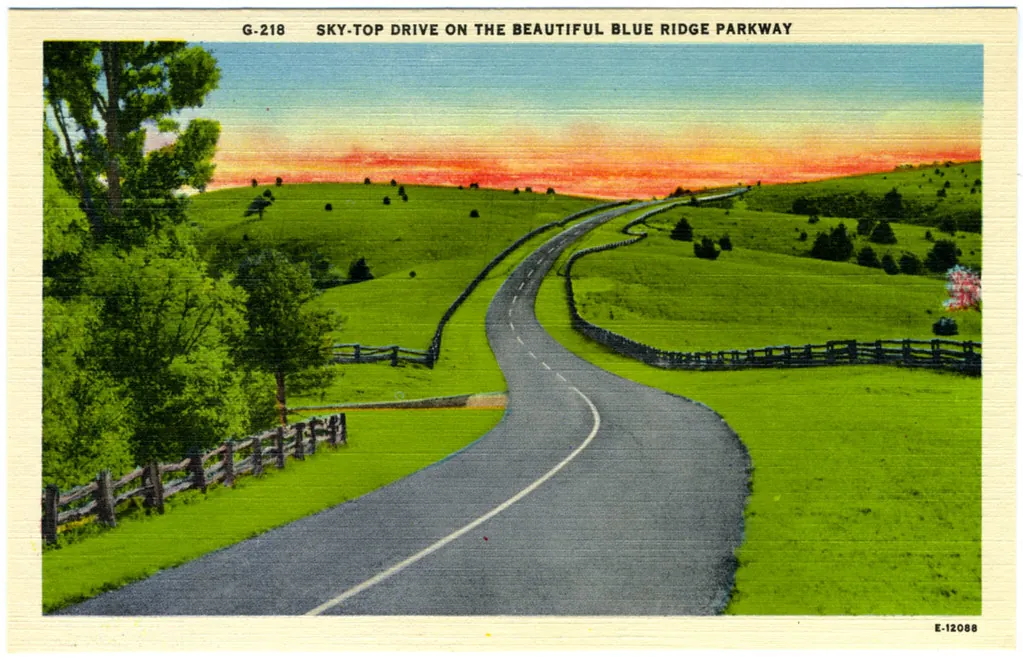
Between Rockfish Gap in Virginia and the Cherokee boundary in North Carolina, the Blue Ridge Parkway runs 469 miles along the spine of the Appalachian Mountains. It has been the most-visited unit of the National Park Service every year since 1946, with four exceptions. The road itself is the attraction — a two-lane expressway where interchanges and grade separations allow for freer flowing traffic and better vistas than frequent intersections and stoplights would permit.
Construction started September 11, 1935, near Cumberland Knob in North Carolina. The project took 52 years. Most of the early work was done by hand — Civilian Conservation Corps crews and private contractors under federal authorization. During World War II, conscientious objectors in the Civilian Public Service program replaced the CCC. For tunneling, they had truck-mounted water-cooled compressed air drills called "Jumbos." After the initial holes were drilled into the substrata, dynamite was used for blasting away the rock. Little machinery was used; the intention was to create manual labor during the Depression.
The parkway displaced residents and imposed new rules: farmers could no longer build without permission, or transport crops on the roadway itself. The Eastern Band of Cherokee resisted giving up the right-of-way through the Qualla Boundary from 1935 to 1940. They won more favorable terms — a $40,000 payment and a requirement that the state build a regular highway through the Soco Valley. Cherokee leaders participated in the dedications when those sections opened in the 1950s.
Asheville sits at the parkway's center. The Folk Art Center at milepost 382 sells traditional and contemporary Appalachian crafts. The Blue Ridge Parkway Visitor Center at milepost 384 — the newest along the parkway — interprets the history and heritage of western North Carolina. Craggy Gardens at milepost 364 turns purple with rhododendron in mid-to-late June. Mount Pisgah at milepost 408.6 was once part of the Biltmore Estate, which became home to the first forestry school in America and the nucleus of Pisgah National Forest.
The parkway crosses no interstates directly. There is no entrance fee. The speed limit never exceeds 45 mph. Sections at high elevation close in winter — ice on the road, ice in the tunnels. Hurricane Helene closed the entire parkway in late September 2024. Sections began to reopen on October 11, 2024. The road endures because the work that built it was patient.
- ·America's most-visited unit of NPS. Listed NRHP 6/19/2008.
Memories
Editorial content compiled with AI assistance. Place details verified against public records.