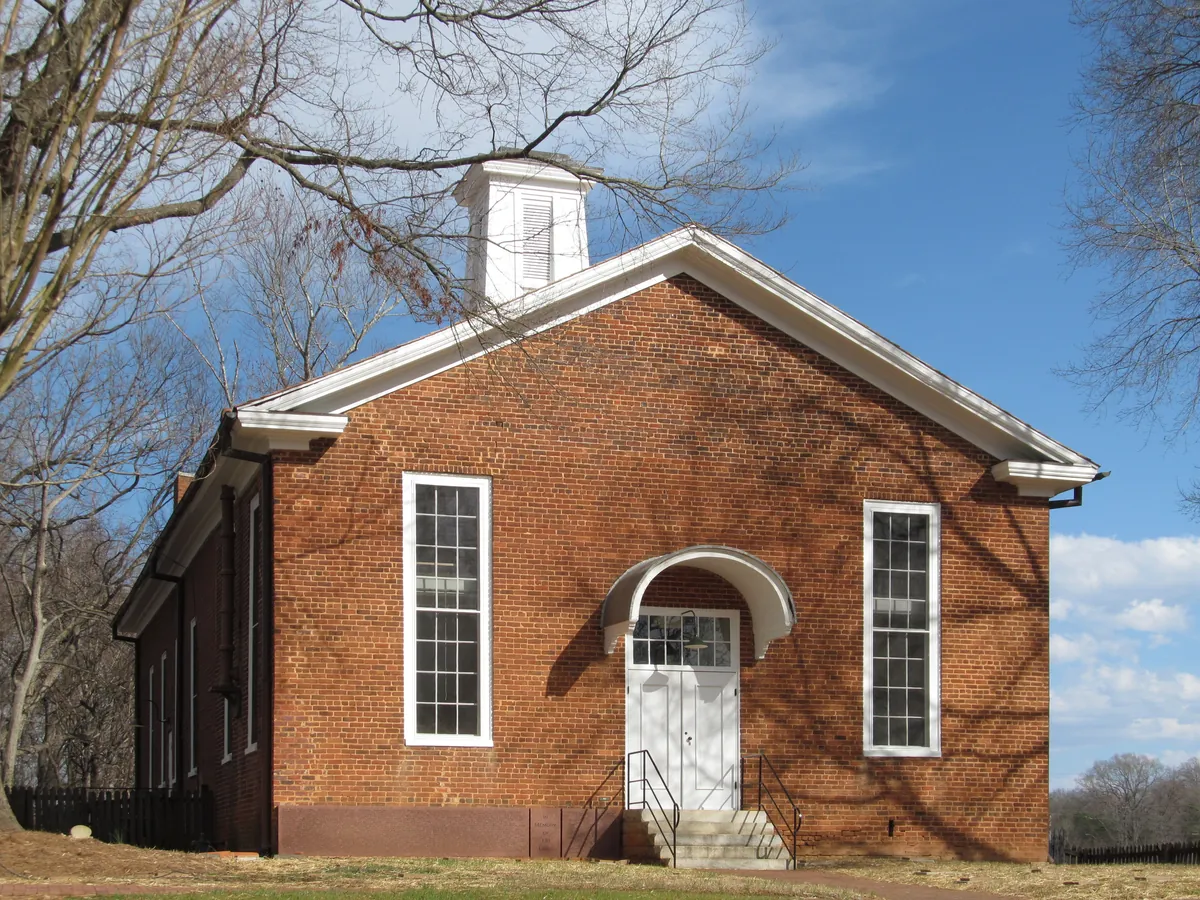
On May 21, 1865, a Union chaplain — Rev. Seth G. Clark of the 10th Regiment, Ohio Cavalry — stood at the pulpit of a Black Moravian church in Old Salem and read General Orders 32 aloud. Freedom, announced here, in this building, to the congregation that had built it.
That congregation organized in 1822, after white Moravians stopped welcoming Black worshippers into their services around 1820. The following year, they built their own log church south of the Strangers Graveyard — the cemetery that had served Salem's African American dead since 1816. Between 1827 and 1831, white Single Sisters taught a Sunday school here, until a state law ended the teaching of literacy to enslaved people. The congregation kept going anyway.
The brick church that stands today went up in 1861 — the oldest surviving African American church building in North Carolina. In 1890 it was enlarged with a central hall, classrooms on the lower level, and a large room above that could open onto the sanctuary. The congregation worshipped here under the blunt institutional label "Negro congregation" until December 1913, when Bishop Edward Rondthaler gave it a name at a lovefeast service: St. Philips. The 1823 log church was reconstructed on its original site in 1999. The entire complex is part of Old Salem, and the grounds were restored by Old Salem Museums and Gardens in 2004 for interpretive use.
St. Philips is the only historically Black Moravian congregation in the United States. The brick church was added to the National Register of Historic Places in 1991. Worship services are still held here.
Salem was a Moravian settlement built on the idea that only church members could live within its boundaries — a controlled, hierarchical community that owned its own property and governed its own life. St. Philips is what happened when that community decided some of its members didn't count. The congregation counted anyway, and built something that outlasted the people who excluded them.
- ·On May 21, 1865, Union chaplain Rev. Seth G. Clark of the 10th Ohio Cavalry read General Orders No. 32 from the pulpit, announcing freedom to the congregation
- ·Congregation organized in 1822 after white Moravians stopped welcoming Black worshippers around 1820; built a log church in 1823
- ·The 1861 brick church is the oldest surviving African American church building in North Carolina
- ·The only historically Black Moravian congregation in the United States; given the name St. Philips at an 1913 lovefeast service
- ·Added to the National Register of Historic Places in 1991; grounds restored by Old Salem in 2004; worship services still held
Memories
Editorial content compiled with AI assistance. Place details verified against public records.