Winston-Salem sits in the northwest Piedmont of North Carolina, 65 miles from the geographic center of the state — close enough to the Appalachian foothills to feel their pull, far enough into the flat interior to be something else entirely. The land drains through Salem Creek and Muddy Creek toward the Yadkin-Pee Dee River Basin, a geography that invited settlement without commanding it. What grew here grew because people decided to build it, not because the terrain left them no choice.
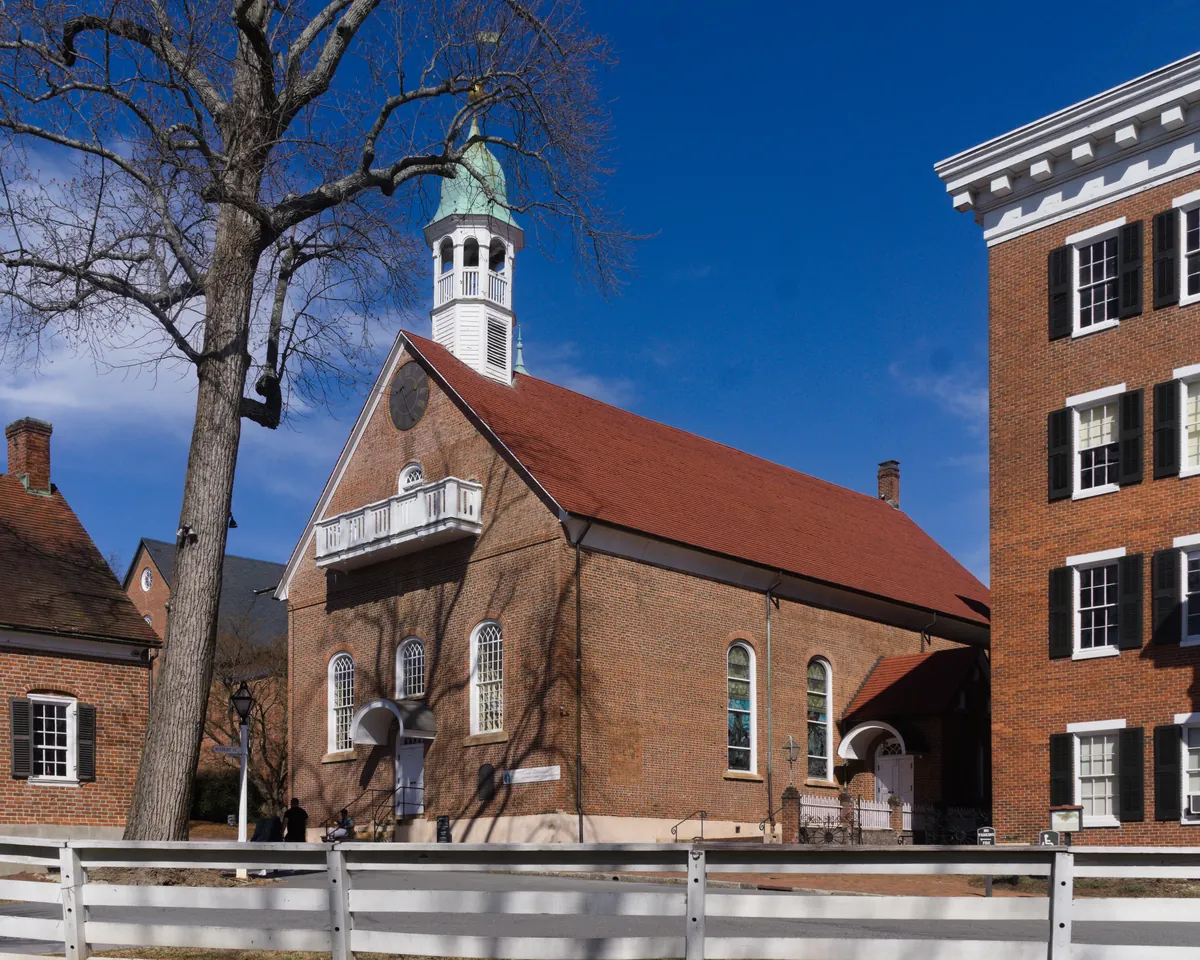
The first decision was made in 1753, when Bishop August Gottlieb Spangenberg, scouting land on behalf of the Moravian Church, selected a site in the three forks of Muddy Creek. He called it "die Wachau," after the ancestral estate of Count Nicolaus Ludwig von Zinzendorf. The congregation purchased nearly 99,000 acres from the Earl Granville and began settling in stages — first Bethabara, then Bethania, then a permanent town chosen by lot. On January 6, 1766, the first tree was felled for Salem, named from the Hebrew word for peace. It was a congregation town: the church owned the property, the public buildings gathered around a central square, and for decades only Moravians could live there. The community ran on its own terms, by its own rules, and built its own institutions — including Salem Academy, which has educated women continuously since 1772, making it the oldest such institution in the country still operating.
The second town came later and from different logic. In 1849, the Salem congregation sold land to the north for a county seat. That town was named Winston in 1851, for Revolutionary War soldier Joseph Winston, and spent its first two decades going nowhere in particular. The railroad changed that. In 1868, business leaders from both towns pushed to connect Winston to the North Carolina Railroad. By the 1880s, tobacco factories had multiplied. R.J. Reynolds founded his company in 1875. Pleasant Hanes built his own factory. The post office had already started writing both names together, and in 1913, after years of informal merger, the two towns made it official.
What tobacco built here was not subtle. By the 1940s, 60 percent of Winston-Salem's workers drew paychecks from Reynolds or the Hanes textile mills. Reynolds imported so much French cigarette paper and Turkish tobacco for Camel cigarettes that the federal government designated the city — 200 miles from the nearest coast — an official U.S. port of entry. By 1916, it ranked eighth in the country by that measure. In 1929, Reynolds built its headquarters: a 21-floor, 314-foot skyscraper designed by William F. Lamb of the firm Shreve, Lamb and Harmon — the same architect, the same firm that would finish the Empire State Building two years later. The American Institute of Architects named the Reynolds Building the best building of that year. It was the tallest building in the United States south of Baltimore when it opened.
The city those industries funded built more than cigarettes and socks. In 1892, Simon Green Atkins founded Slater Industrial Academy, which grew into Winston-Salem State University, a public HBCU still operating today. The city created the first arts council in the United States in 1949. Wake Forest University relocated here in 1956, and the University of North Carolina School of the Arts — the first public arts conservatory in the country — eventually joined the city's six-college roster. In 1981, R.E.M. recorded its debut EP, *Chronic Town*, at a recording studio set up in a garage here, part of an early indie rock scene that drew artists including Suzanne Vega and Pylon. The Moravian sunrise service at God's Acre Cemetery, held every Easter since 1772, still draws thousands. The C. Winkler Bakery, commissioned in 1799, still operates in Old Salem, where seventy percent of the original 18th-century buildings survive.
Two towns became one city because tobacco and textiles made the merger inevitable. What the city did with that money — the universities, the arts institutions, the preserved congregation town at its center — is the longer story. The industrial logic is mostly gone. The things it made are still here.