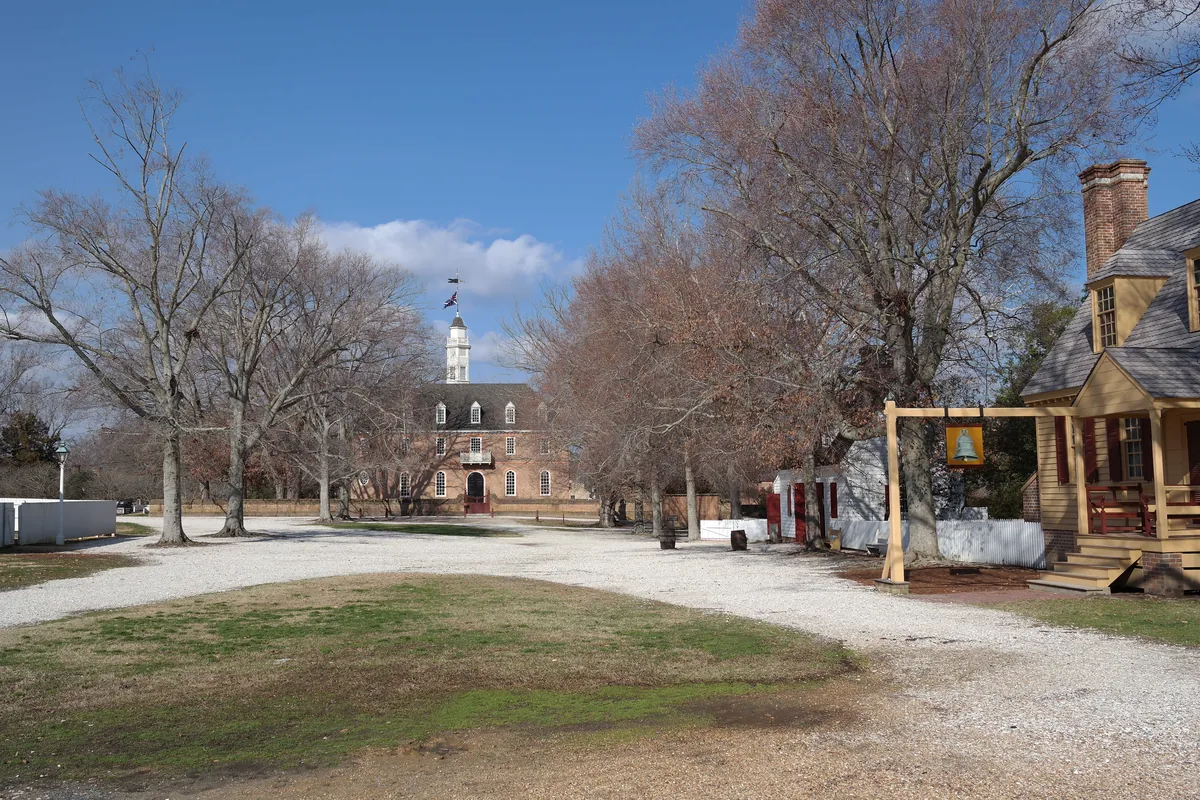
Williamsburg sits on a ridge of the Virginia Peninsula, positioned strategically on high ground between the James and York Rivers. English settlers chose this inland location as Middle Plantation in 1632, a fortified settlement built for defense. Its place on this natural divide defines it: a point of control, a buffer, a strategic anchor.
Between 1630 and 1633, after the war that followed the Indian massacre of 1622, English colonists built a defensive palisade across the peninsula, with Middle Plantation as a primary guard station. When Jamestown, the original colonial capital, burned during Bacon's Rebellion in 1676, the government moved its operations here temporarily. The high ground, away from Jamestown's humidity and mosquitoes, offered a safer, more pleasant alternative. A royal charter established the College of William & Mary at Middle Plantation in 1693, the second-oldest institution of higher education in the United States. Four years later, Jamestown's rebuilt Statehouse burned again. The temporary capital became permanent in 1699; Middle Plantation was renamed Williamsburg, staking its claim as the capital of the Virginia Colony.
For decades, Williamsburg served as Virginia's capital, from 1699 to 1780. It became a crucible of political discourse leading to the American Revolution, proclaiming the Declaration of Independence in July 1776. This period also saw the establishment of the Public Hospital for Persons of Insane and Disordered Minds by act of the Virginia colonial legislature on June 4, 1770, with its building completed in 1771—the nation's first purpose-built psychiatric hospital. The *Virginia Gazette*, first published in 1736, became a vital voice, with Clementina Rind later stepping in as the colony's first woman newspaper publisher. However, in 1780, with the capital moved to Richmond, Williamsburg began a decline. Unlike other early communities, it lacked a major water-route or early railroad access, losing the flow of commerce and influence. During this Revolutionary era, African Americans comprised over half of Williamsburg's population.
The College of William & Mary and the Eastern State Hospital endured, even as the city faded from its former prominence. The Civil War brought combat to Williamsburg in May 1862, with the Battle of Williamsburg delaying Union forces and allowing Confederate troops to reach Richmond's defenses. The college closed, its building burned by Union soldiers. Post-war, College President Benjamin S. Ewell led the efforts to restore the school, successfully securing funding from both Congress and Virginia, and reopening in 1888. The arrival of Collis P. Huntington's Chesapeake and Ohio Railway in 1881 reconnected the peninsula, yet the city's pace remained slow. An editorial in the *Richmond Times-Dispatch* in 1912 dubbed it "Lotusburg," noting its tranquil, almost forgotten character.
That quiet character, however, proved to be its salvation. Episcopal priest Dr. W. A. R. Goodwin, after restoring Bruton Parish Church, saw the deterioration of other colonial buildings. He envisioned a much larger restoration, a vision that captured the interest and financial backing of Standard Oil heir John D. Rockefeller Jr. and his wife Abby Aldrich Rockefeller. Their combined efforts, starting in the early 20th century, created Colonial Williamsburg, a sprawling 301-acre Historic Area dedicated to a meticulous, large-scale recreation of the colonial past. It was a monumental undertaking, not just preserving structures, but actively interpreting a complex history.
Williamsburg endures, a city shaped by ambition, conflict, and a deliberate act of historical preservation. The College of William & Mary continues to draw students, shaping a college town identity. Colonial Williamsburg, now Virginia's largest tourist attraction, continues to evolve, working to interpret the full human experience of its colonial past, including the lives of Black Americans. This is a place that chose to rebuild its past, and in doing so, created its future.