Tucson
The Old Pueblo — four thousand years of desert farming, and America’s first UNESCO City of Gastronomy.
Tucson sits in a basin the desert made. The Santa Cruz River — now dry for most of the year, flooding hard when the monsoon arrives — runs through an alluvial plain ringed by mountain ranges on every side: the Santa Catalinas to the north, the Rincons to the east, the Santa Ritas to the south, the Tucson Mountains to the west. The elevation runs over 2,600 feet. The geography is not incidental — it is the argument. Everything that made this city was shaped by that basin: the water that drew the first farmers, the defensible position that drew the Spanish fort, the dry air that drew the tubercular and the veteran and, eventually, the astronomer.
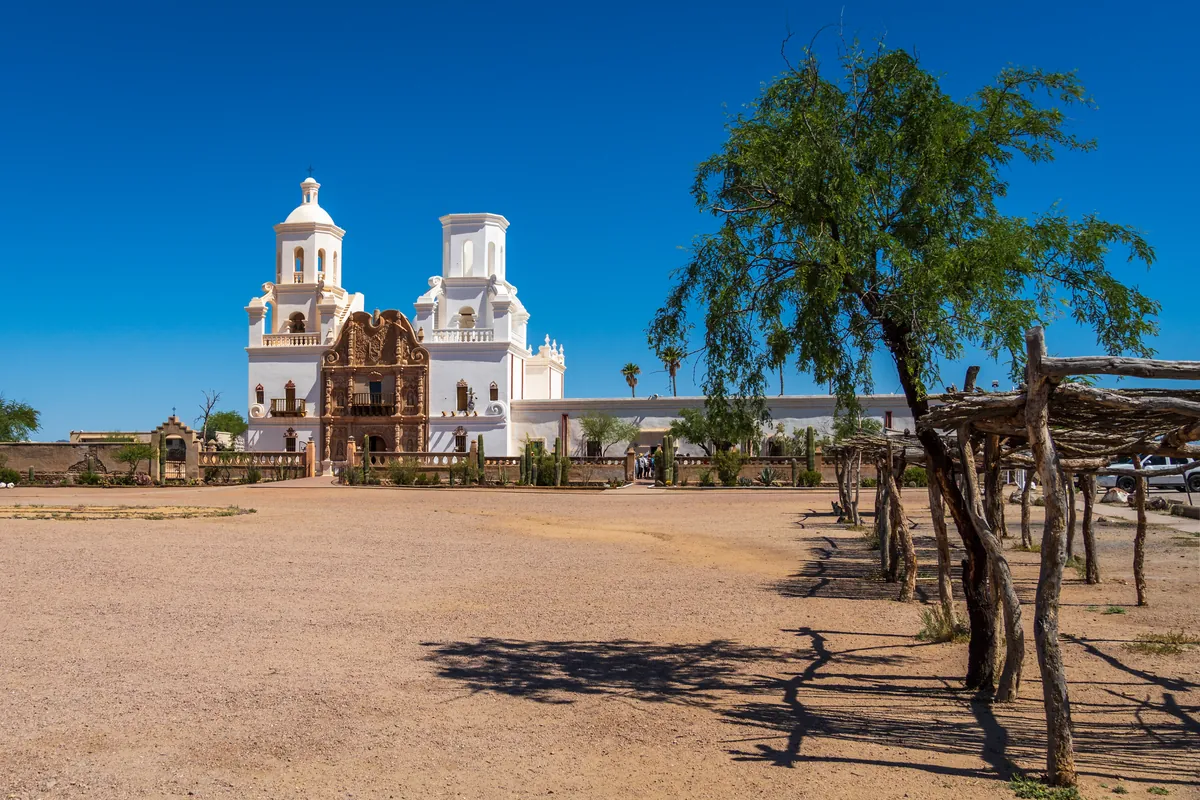
People have been working this ground for a long time. Archaeological evidence near the Santa Cruz River places a village here as far back as 2100 BC. The Hohokam, who occupied the area from roughly AD 600 to 1450, built irrigation canal systems extensive enough to sustain permanent agriculture in the Sonoran Desert — infrastructure that predates the city's founding by more than a millennium. The Italian Jesuit missionary Eusebio Francisco Kino arrived in the Santa Cruz valley in 1692 and founded Mission San Xavier del Bac in 1700, about seven miles upstream from what would become Tucson proper. The Spanish military formalized the settlement on August 20, 1775, when Hugo O'Conor authorized the construction of Presidio San Agustín del Tucsón — a fort positioned at the base of the basalt-covered hill the O'odham called Cuk Ṣon: the dark base. The name stuck. So did the pattern: Tucson as a place where people came to hold something.
The United States acquired Tucson through the Gadsden Purchase in 1853 — the city had been part of Mexico since 1821 — and formal American military control began in 1856. The town incorporated in 1877, making it the oldest incorporated city in Arizona. It served as the territorial capital from 1867 to 1877. The arrival of rail service in 1880 was significant enough that Mayor Leatherwood sent telegrams to the President and the Pope announcing that the "ancient and honorable pueblo" was now connected to the wider world. The boosterism was real, and so was the history underneath it: the city had already accumulated three centuries of layered occupation before American settlement arrived to add its own.
What the territorial legislature did in 1885 changed the city's long-term character more than any fort or railroad. They chartered the University of Arizona on overgrazed ranchland between Tucson and Fort Lowell — a land-grant college that became the city's largest employer and the engine of its intellectual life. The university's Steward Observatory is now one of the few places in the world that can cast the enormous mirrors used in major telescopes; roughly 150 Tucson companies work in optics and optoelectronics, enough to earn the city the nickname "Optics Valley." The dry, high-altitude air that once drew tuberculosis patients turned out to be equally useful for seeing stars.
The city's food culture runs just as deep. Tucson's cuisine is the product of every group that passed through or stayed: O'odham, Spanish, Mexican, Anglo rancher, Chinese railroad worker. The Sonoran hot dog — bacon-wrapped, grilled, served on a bolillo bun with pinto beans and tomatoes — is a local institution. The chimichanga has a contested but plausible claim to have been invented here. Chinese Chorizo, a Sino-Mexican fusion sausage tracing to Chinese grocery stores operating in Tucson from the 1880s to the 1970s, is its own argument for how thoroughly this city mixed its influences. In 2015, UNESCO designated Tucson the first American city in its Creative Cities Network as a City of Gastronomy — recognition that the food here isn't fusion in the trendy sense but the accumulated result of four thousand years of people feeding themselves in the Sonoran Desert.
The writers came too: Edward Abbey, Barbara Kingsolver, Leslie Marmon Silko, David Foster Wallace — some attached to the university, others simply choosing the place. Linda Ronstadt grew up here. The Tucson International Mariachi Conference has run annually since 1982. The punk scene has operated continuously since the late 1970s. The All Souls Procession, modeled on Día de los Muertos and begun in 1990 with 35 participants, draws an estimated 50,000. What Tucson built, across centuries and under multiple flags, is a city where the cultures didn't simply coexist — they cooked together, played together, and made things that didn't exist anywhere else.