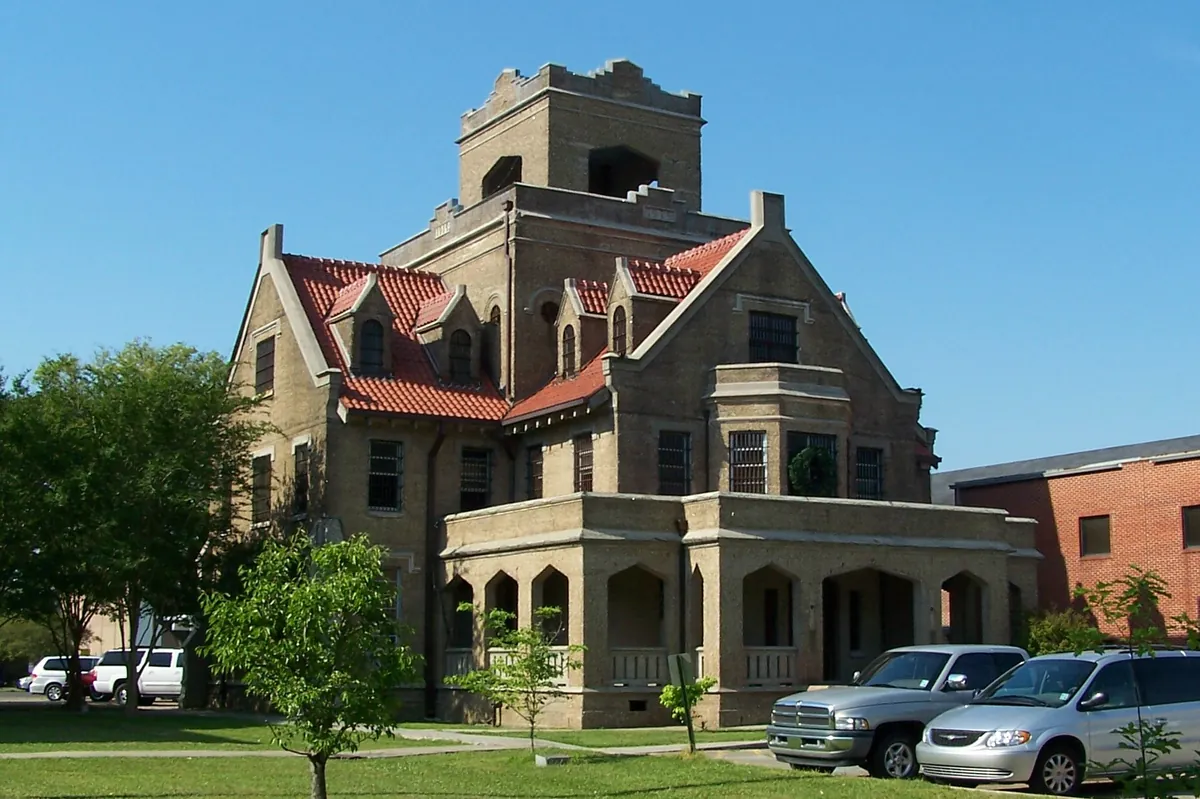
Stevens-Nelson of New Orleans designed a courthouse and jail for the newly formed Beauregard Parish, carved from old Imperial Calcasieu. The Hudson River Lumber Company had donated land to DeRidder; the Police Jury purchased additional property and a building from a church. Falls City Construction Company finished both structures in 1915 for $168,000. The jail, completed in 1914, went up in Gothic Revival style—what architectural historian Jonathan Fricker called possibly "the only penal institution in the country using 'Collegiate Gothic' design in the first decade of the 20th century."
Each cell had a toilet, shower, lavatory, and window. A large spiral staircase connected the floors. The jailer lived downstairs with a kitchen. A tunnel ran from the courthouse to the jail for transporting prisoners to trial. The building could house over fifty prisoners.
On March 9, 1928, Joe Genna and Molton Brasseaux were hanged inside for the murder of J.J. Brevelle, a taxi driver killed by his fares while driving them to a rural destination. Deputy Sheriffs Jim Crumpler and Gill served as hangmen. Genna, twenty-five, was pronounced dead at 1:06 PM; Brasseaux at 1:29 PM. Neither man was buried in Beauregard Parish. It was the only double hanging in the parish's history, and afterward the jail gained a second name: the Hanging Jail.
The gallows are still intact on the third floor, reached by the original interior stairwell. The jail was listed on the National Register of Historic Places in 1982. The building is no longer in use; the Beauregard Parish Police Jury owns it, with the Rehabilitation Committee working to preserve it and the Tourist Commission involved in securing its future. Tours run Thursday through Saturday, with admission shared between the Gothic Jail and the 1915 courthouse next door.
- ·Built in 1914 by architect J.W. Smith in collegiate Gothic style — rare for any American jail
- ·Site of the only double hanging in Beauregard Parish history, March 9, 1928
- ·The gallows are still intact on the third floor, reached by the original interior stairwell
- ·Listed on the National Register of Historic Places in 1982
- ·Visitor tip: tours Thursday–Saturday; the Gothic Jail and 1915 Courthouse next door share an admission
Memories
Editorial content compiled with AI assistance. Place details verified against public records.