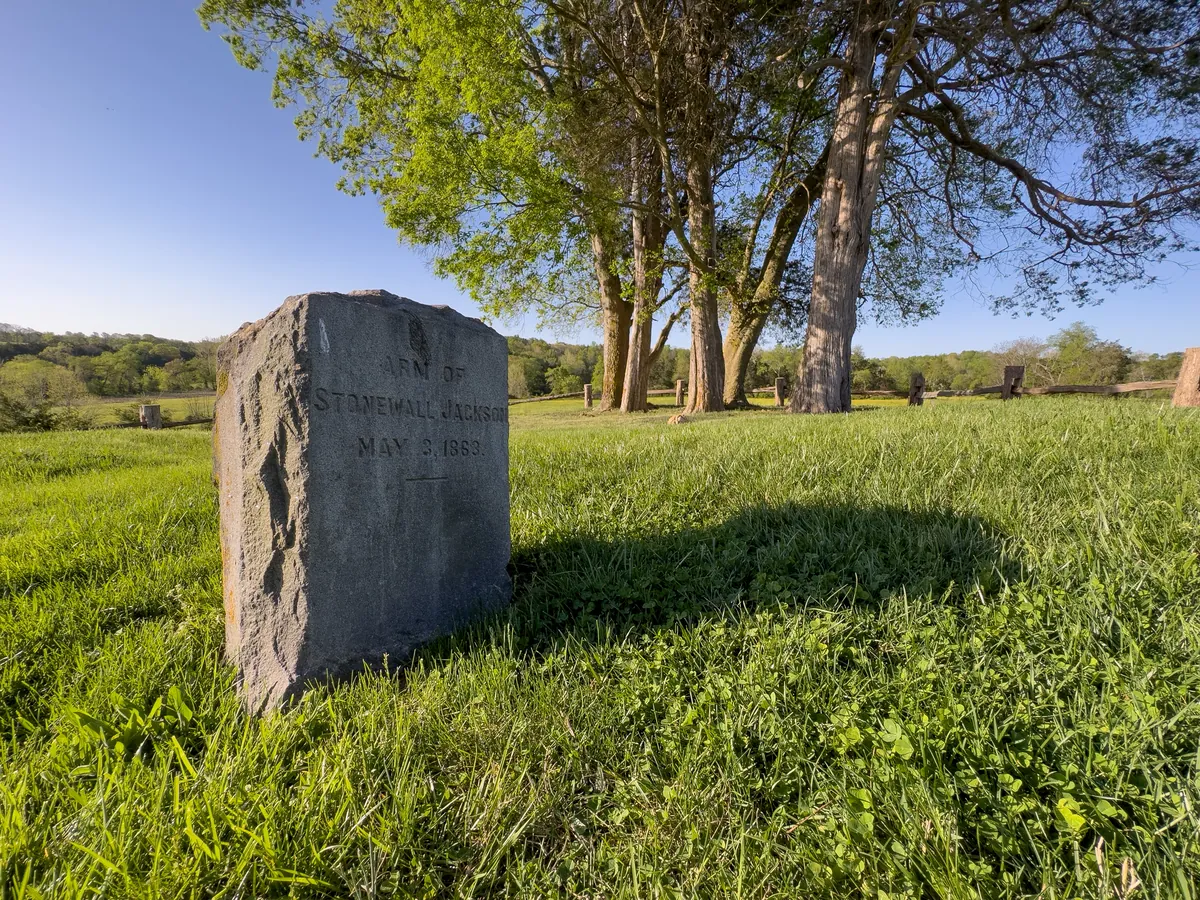
The surgeon's saw took Stonewall Jackson's left arm on May 2, 1863, hours after friendly fire cut him down during his own night reconnaissance at Chancellorsville. Chaplain Beverly Tucker Lacy found the limb wrapped for a ditch burial with other amputated arms and legs, decided it deserved better, and had it buried in his family plot at Ellwood Manor. Jackson died eight days later. His widow, asked if she wanted the arm exhumed for burial with the general, said no — the limb had received Christian rites.
The next year, during the Battle of the Wilderness, a Federal soldier reported in his diary that some of his men had dug up the arm and reburied it, location unknown. In 1903, former Jackson staff officer James Power Smith placed a granite marker reading "Arm of Stonewall Jackson May 3, 1863." The National Park Service notes Smith's battlefield markers are "quite approximate in nature" — it's not known how accurately the stone reflects the actual burial site. The cemetery holds fifteen graves. The only monument marks the arm.
In 1921, Marine officer Smedley Butler led a mock battle at the Wilderness. President Warren G. Harding and his wife stayed at Ellwood; Florence Harding visited the arm's grave. By the late 1930s, a story circulated that Butler had ordered Marines to dig for the arm, disbelieving the tale, and that they found it and reburied it in a metal box with a 21-gun salute. The NPS conducted an archaeological study after taking control of Ellwood in 1977. No disturbed earth. No metal box on the detector. A 2010 press release concluded "the arm was never dug up. It certainly was not reburied in the box near the marker." No documentation for the Butler story predates 1940.
A metal plaque reading "A Tribute to the Memory of Stonewall Jackson by the East Coast Expeditionary Force United States Marines. Sept. 26 - Oct. 4, 1921" was once affixed to the marker — when, no one knows. It's in storage now. NPS historian Frank O'Reilly believes Jackson's arm was buried in the area but either no longer exists or lies at a lost location elsewhere in the cemetery. The marker has become a tourist site. In 1998, the NPS added a parking lot and signage to make it easier to reach.
- ·Near Locust Grove in Orange County; part of FRSP Wilderness Battlefield unit. Marker reads 'Arm of Stonewall Jackson, May 3, 1863.' 1998 NPS archaeological investigation found no specific burial site. Coordinates approximate.
Memories
Editorial content compiled with AI assistance. Place details verified against public records.