The Rappahannock River defines this city before anything else does. Where the river crosses the fall line — the geologic boundary where the Piedmont meets the Tidewater coastal plain — the water stops being navigable for large vessels. That is the point. Before the English arrived, the Manahoac people occupied this inland territory. When colonial Virginia's frontier shifted west from the coast, the fall line was the logical place to build the hinge: goods moving down from the interior could go no farther by water, so a town would have to collect them. Fredericksburg was that town.
The Virginia General Assembly named it in 1728 for Frederick, Prince of Wales, and the streets inside it for his relatives — a thoroughly colonial act of flattery that nevertheless produced a functioning market town. Tobacco went out; manufactured goods came in. The county court arrived in 1732, making Fredericksburg the seat of Spotsylvania County, and for the next half-century the town was a genuine center of political and commercial life in Virginia. The Washington family purchased Ferry Farm, just across the river, in 1738. George Washington's mother Mary would later live in the city itself; his sister Betty lived at Kenmore, the plantation house of Fielding Lewis, who ran an arms factory there for the Continental Army. Thomas Jefferson wrote the Virginia Statute for Religious Freedom in Fredericksburg. James Monroe practiced law here. John Paul Jones passed through. The place was not incidental to the founding of the country — it was one of its working rooms.
The Civil War arrived with the particular cruelty geography reserves for cities positioned exactly in the middle of things. Halfway between Washington and Richmond, between the capitals of two sides that needed to defeat each other, Fredericksburg endured bombardment, occupation, and looting during the Battle of Fredericksburg in December 1862, then fighting again the following May during the Second Battle of Fredericksburg, with the battles of the Wilderness and Spotsylvania Court House following nearby in 1864. The city was used, and used hard. What the brief record preserves alongside the military casualty figures is something else: in 1862 alone, nearly 10,000 enslaved people left area plantations and crossed the Rappahannock to Union lines. Among them was John Washington, a literate man from Fredericksburg who later wrote down what he saw — the riverbank, the Union troops approaching, and the streets occupied only by Black residents watching it happen. His manuscript surfaced in the 1990s and became the basis of two published books. The National Park Service later marked both sides of the river as a Freedom Trail. The city could not get over what happened to it. What it left behind was more than rubble.
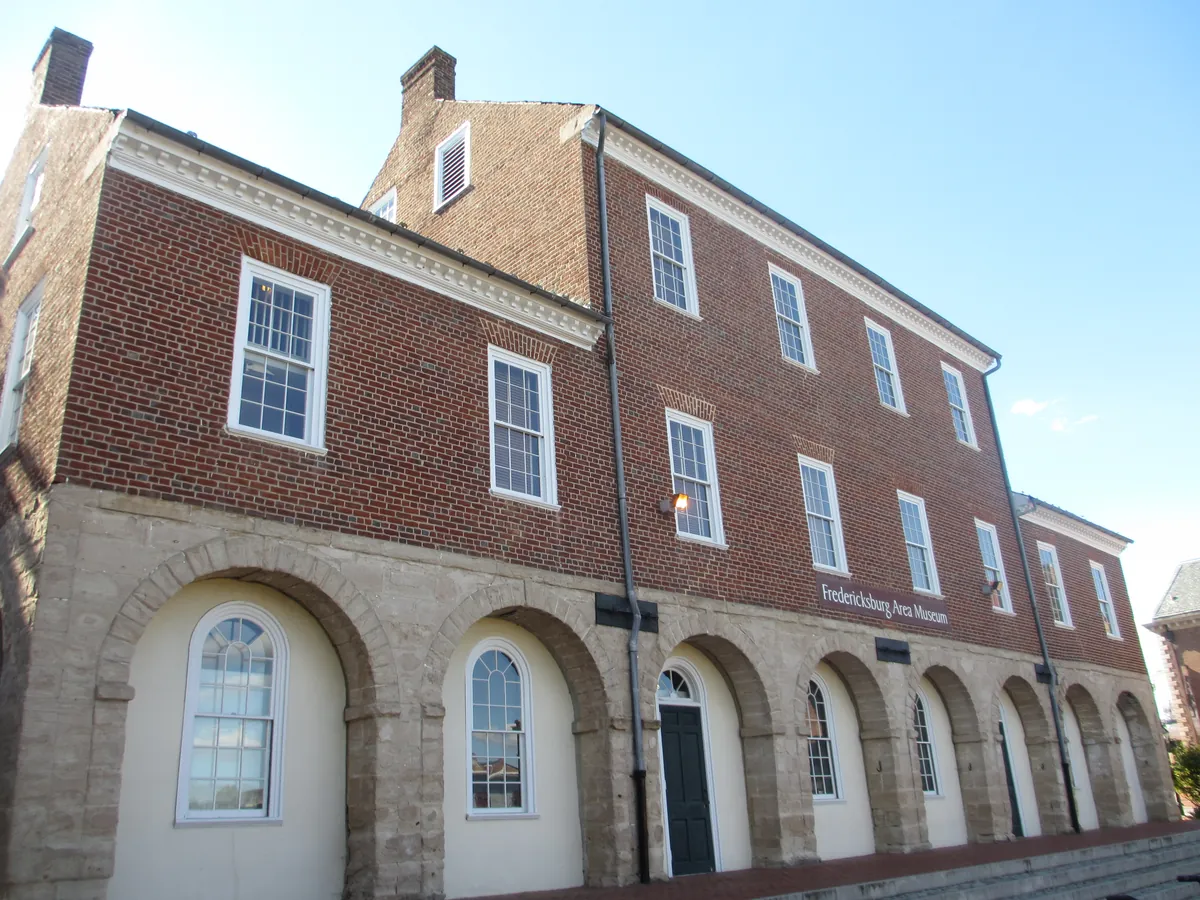
The population did not return to its 1860 level until well into the twentieth century. What the long contraction preserved — accidentally, through economic stagnation rather than civic virtue — was the built fabric of the eighteenth and nineteenth centuries. The 40-block Fredericksburg Historic District now holds more than 350 buildings and sites from those eras, including the Rising Sun Tavern, the Hugh Mercer Apothecary Shop, and the Mary Washington House, where George Washington's mother lived her final years. The 1852 courthouse was designed by James Renwick, the same architect who built St. Patrick's Cathedral in New York. A city that couldn't afford to tear things down kept them by default, and what it kept turned out to matter.
One more thing the brief documents, small in scale but not in consequence: in 1958, a musician named Link Wray was playing an improvisation in Fredericksburg and produced the distorted, menacing guitar tone that became the power chord — the foundational sound of rock guitar as it has been played ever since. The innovation happened here, in this city of colonial records and battlefield markers and presidential boyhood homes. That is the Fredericksburg pattern: history accumulates in layers it didn't plan, and what endures is never only what anyone intended to preserve.