Charleston
Every cobblestone holds a story the country hasn't fully reckoned with yet.
Charleston sits at the confluence of the Ashley and Cooper rivers, where the harbor opens southeast toward the Atlantic. The position was not chosen for scenery. It was chosen for control — of deep water, of trade routes, of the coastline between the Spanish holdings to the south and the English colonies to the north. When settlers moved their original encampment from Albemarle Point to Oyster Point in 1680, they were making a military and commercial argument: this peninsula, with its natural harbor and defensible approaches, was worth holding.
The English crown had granted the Province of Carolina to eight Lords Proprietors in 1663, and the first shiploads of settlers — many of them planters from Barbados and Bermuda — arrived in 1670. They brought with them the plantation economy of the West Indies and the enslaved people who made it run. By 1690, Charles Town was the fifth-largest city in North America. By 1708, Black Africans were a majority of the colony's population. Almost half of all enslaved people brought to North America entered through this harbor — many through Sullivan's Island, many through Gadsden's Wharf, which stretched 840 feet into the Cooper River. The wealth that built the Greek Revival houses and the church spires and the Library Society of 1748 and America's first theater building in 1736 was built on that fact. The brief does not allow evasion of it, and neither does the city.
What that pressure produced, alongside its atrocities, was something harder to categorize. Planters who needed workers from the "Rice Coast" paid premiums for people with specific agricultural knowledge — and the descendants of those people became the Gullah, a community with its own language, its own foodways built around Carolina Gold rice and okra and benne seeds, and a cultural continuity that neither slavery nor Reconstruction nor gentrification fully broke. The geechee dances of the dock workers followed a rhythm that traveled north and became the Charleston — the dance that defined the 1920s — by way of composers who absorbed what they heard on these wharves. The Jenkins Orphanage, founded in 1891 by the Rev. Daniel J. Jenkins, took in boys, accepted donated instruments, and trained them in music with rigor. Jenkins Orphanage alumni landed positions in big bands with Duke Ellington and Count Basie. The band played in the inaugural parades of Presidents Theodore Roosevelt and William Taft. When DuBose Heyward's novel *Porgy* went to Broadway in 1927, the Heywards insisted on the actual Jenkins Orphanage Band — no substitutes. George Gershwin spent the summer of 1934 at Folly Beach, outside Charleston, working with Heyward on what became *Porgy and Bess*.
The city's other enduring institution came out of repression. In 1817, thousands of Black Methodists left a congregation that had erected a hearse house over its Black burial ground, and joined Morris Brown in establishing what is now Emanuel African Methodist Episcopal Church — the oldest AME church in the South, the oldest Black congregation south of Baltimore. The city burned its predecessor church to the ground in 1822 following Denmark Vesey's planned uprising. The congregation rebuilt. The city banned Black worship services in 1834. The congregation endured. In June 2015, a white supremacist killed nine people inside Emanuel during a Bible study. The congregation held. That is the Mother Emanuel pattern, and it is also, in some ways, the Charleston pattern: what survives the worst of what was done here tends to outlast the doing of it.
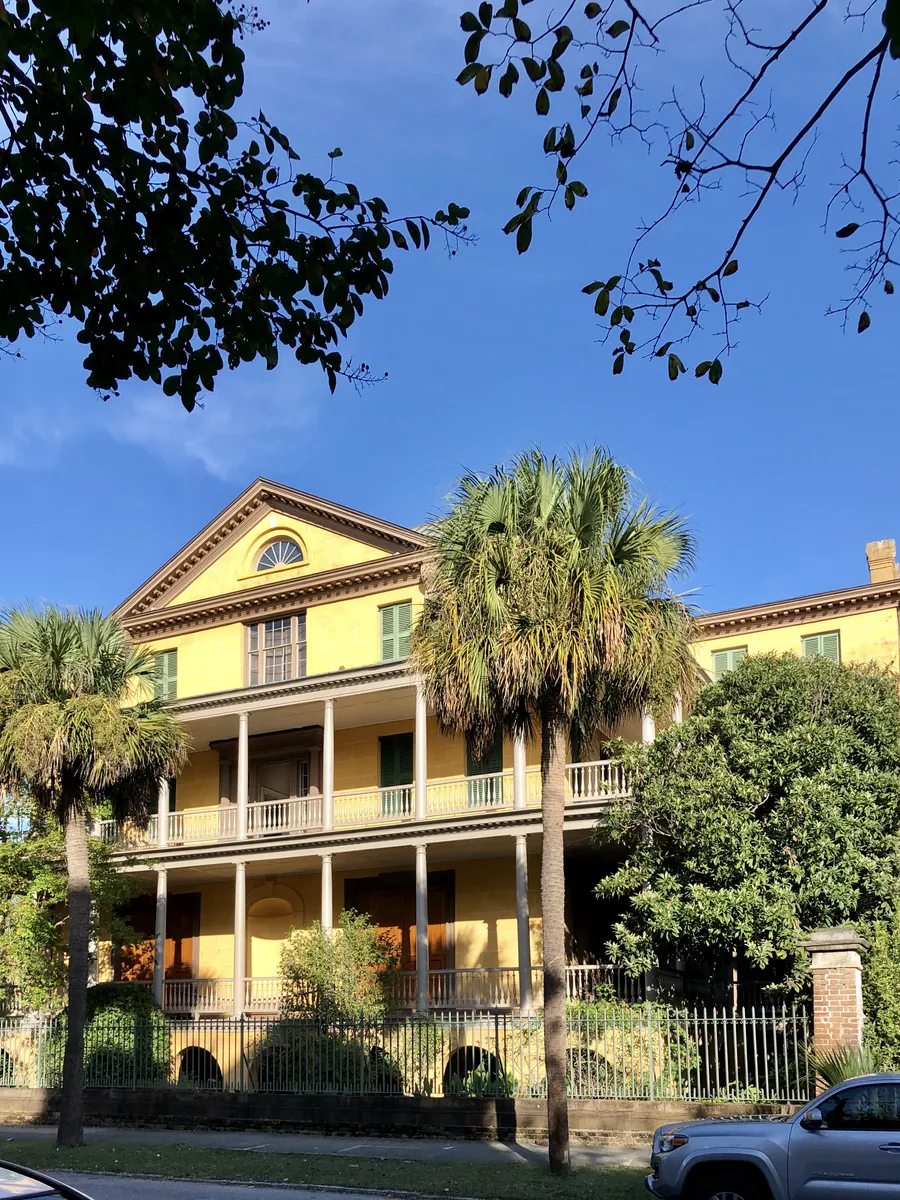
The catastrophic fire of 1838 burned more than a thousand buildings. The city rebuilt in Greek Revival and Gothic Revival. The 1886 earthquake — magnitude 7.0, felt from Boston to Cuba — damaged two thousand buildings. The city rebuilt. The Civil War began here, in Charleston Harbor, on April 12, 1861, when Confederate batteries opened fire on Fort Sumter; it left the city economically shattered. The city eventually rebuilt, slowly, which had an unintended consequence: a downtown that couldn't afford demolition is today one of the most intact collections of pre-Civil War architecture in the country. Charleston's poverty preserved Charleston's beauty, the way poverty sometimes does.
What those forces produced is a city that carries its history in its bones — in Gullah foodways that shape every serious kitchen in town, in church spires that gave the city the nickname "the Holy City," in a harbor deep enough to handle ships too large for the Panama Canal, in the International African American Museum that opened in 2023 on the ground where enslaved people were once sold. The city formally apologized for its role in the slave trade in 2018. The accounting is ongoing. What was built here — the cuisine, the music, the institutions, the architecture — was built by everyone who ever moved through this harbor, willing or not. Charleston knows that now, or is learning it.