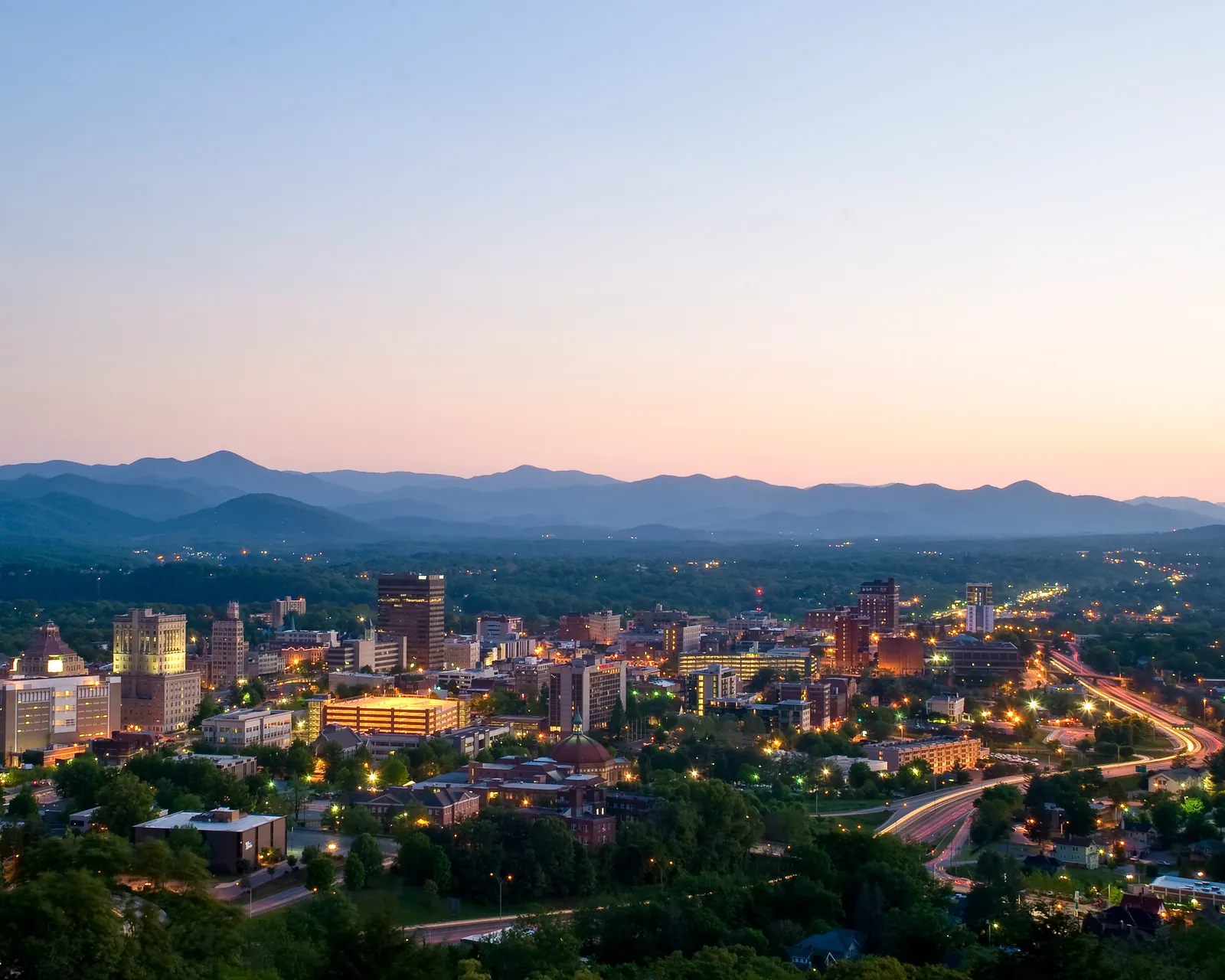
Asheville sits in a mountain bowl at the confluence of the French Broad and Swannanoa rivers, surrounded by the Blue Ridge. The elevation moderates what would otherwise be a Southern climate — summers that stop short of brutal, winters that stay cold without committing to harsh. The mountains made the city hard to reach, which shaped everything.
The Cherokee called the river confluence *Untokiasdiyi* — "where they race" — and used it for open hunting and meeting. European settlement began in 1784, when Colonel Samuel Davidson and his family arrived in the Swannanoa Valley on a soldier's land grant. He built a cabin at the bank of Christian Creek and was killed soon after by Cherokee hunters resisting encroachment. His family fled overnight. Months later, his twin brother Major William Davidson and other members of the extended family returned and settled at the mouth of Bee Tree Creek. By 1793, a county seat called Morristown had been platted on a plateau where two Indian trails crossed. Four years later it was incorporated and renamed Asheville, after North Carolina Governor Samuel Ashe.
The railroad arrived October 3, 1880, and the city the railroad found was not the city it left behind. The Western North Carolina Railroad's line from Salisbury to Asheville ended the isolation and immediately drew industrial investment — textile mills, wood and mica processing, manufactured goods. By 1900 Asheville was the third-largest city in the state. Wealth followed, and wealth meant ambition. George Vanderbilt's Biltmore Estate — the largest privately owned house in the United States, now a National Historic Landmark — belongs to this era. So does the Grove Park Inn, built in the Arts and Crafts tradition. So does Richard Sharp Smith's Asheville Masonic Temple, completed in 1913. The city was building for permanence.
Then the Depression hit, and hit harder here than almost anywhere. On November 20, 1930, eight local banks failed. Wachovia, kept liquid by cash from Winston-Salem, was the only one that didn't close. The per capita bonded debt — accumulated through the explosive growth of the previous decades — was the highest in the nation. Rather than default, the city chose to pay it off over fifty years. Construction stopped. Downtown froze. And that financial paralysis, held in place for half a century, accidentally produced one of the most intact collections of Art Deco architecture in the United States. The buildings survived because no one had the money to tear them down.
What grew inside that preserved shell is harder to manufacture. Thomas Wolfe was born here, grew up here, and set his first novel — *Look Homeward, Angel*, published in 1929 — largely in a fictionalized Asheville he called Altamont. F. Scott Fitzgerald wrote at the Grove Park Inn. In 1928 Bascom Lamar Lunsford started the Mountain Dance and Folk Festival — said to be the first event ever labeled a folk festival — and the tradition of serious outdoor music here has not stopped since. The YMI Cultural Center, which began in 1893 as the Young Men's Institute, has stood as one of the nation's oldest African-American cultural centers; in 2025 it completed a $6.5 million renovation. In 2022, two Asheville restaurants — Chai Pani and Cúrate — received James Beard Awards.
In September 2024, Hurricane Helene sent the French Broad and Swannanoa over their banks in a flood the city had never seen. The municipal water system was catastrophically damaged. Bridges washed out. Interstate access was cut. The full extent of the destruction is still being measured. What Asheville does with that is the next chapter in a story that has always been about a mountain city deciding, repeatedly, to stay.