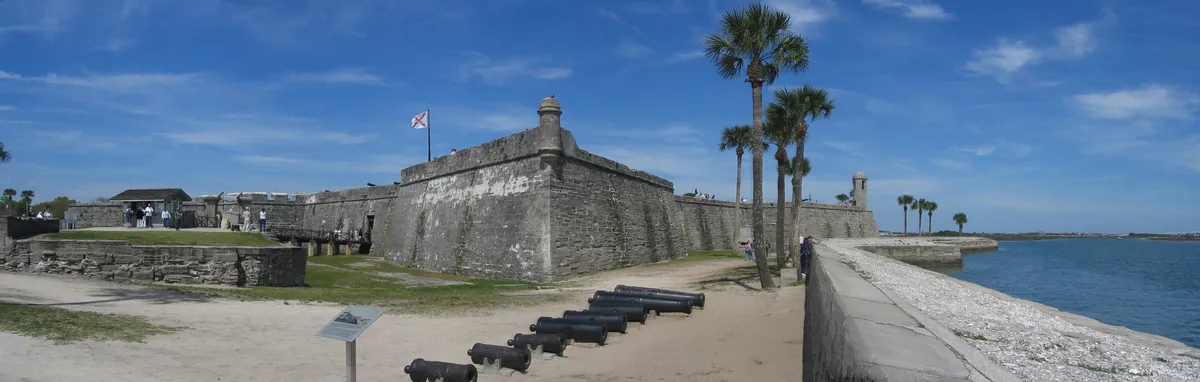
St. Augustine sits on Florida's Atlantic coast, 40 miles south of Jacksonville, a low-lying humid subtropical pocket of land at the mouth of the Matanzas River. For thousands of years, the Timucua and Mocama peoples lived here, fishing, harvesting shellfish, and cultivating crops like maize, beans, and squash.
Spanish admiral Pedro Menéndez de Avilés founded St. Augustine on September 8, 1565. He named the settlement San Agustín because his ships, carrying settlers and supplies, first sighted land on August 28, the feast day of St. Augustine. This made it the oldest continuously inhabited European-established settlement in what is now the contiguous United States. It served as the capital of Spanish Florida for over two centuries, a period marked by pirate raids and battles with the British. The Castillo de San Marcos, a permanent masonry fortress, was completed in 1695 as a defense against these incursions. The Spanish also established Fort Mose in 1738, the first legally recognized free Black settlement in what is now the United States, populated by former slaves who enlisted in the Florida militia.
Florida became British territory in 1763, then returned to Spanish rule in 1783, after the American Revolutionary War. Menorcan settlers, refugees from a troubled settlement to the south, formed a significant part of St. Augustine's population during this period. When Spain ceded Florida to the United States in 1819, St. Augustine briefly served as a territorial capital before Tallahassee assumed the role permanently in 1824. The city saw conflict during the Seminole Wars, with Seminole prisoners, including leader Osceola, held at the Castillo de San Marcos, then renamed Fort Marion.
In the 1880s, Henry Flagler, a co-founder of Standard Oil, saw St. Augustine as a winter resort for the wealthy. He built the Florida East Coast Railway, opening up the Atlantic coast, and constructed opulent hotels like the Hotel Ponce de Leon and the Hotel Alcazar. His investments introduced modern infrastructure and reshaped the city's architecture, setting a precedent for urban planning and establishing tourism as the dominant local industry.
Decades later, St. Augustine became a crucible of the Civil Rights Movement. In the spring of 1964, local activists and leaders like Robert Hayling, joined by Martin Luther King Jr. and the SCLC, organized protests against segregation. Images of demonstrators facing violence, including muriatic acid poured into a segregated pool, were broadcast globally, contributing to the passage of the Civil Rights Act of 1964.
Today, St. Augustine’s history is preserved in its 17th-century fort, historic downtown, and the architectural legacy of its Gilded Age. The city continues to host cultural events and reenactments, a testament to what endured and what was built across its long history.