Savannah sits on the Savannah River, twenty miles upstream from the Atlantic, founded in 1733 at Yamacraw Bluff as the first city in Georgia. General James Oglethorpe landed with settlers from the ship *Anne*, met by the Yamacraw people and traders John and Mary Musgrove, who interpreted. This bluff became the heart of the colonial Province of Georgia, a port city built on a grid of squares that endures today.
As the southernmost commercial port in the Thirteen Colonies, Savannah was a strategic target. British troops seized it in 1778 during the American Revolutionary War. A combined American and French force, including Haitian soldiers, failed to dislodge the British in the 1779 Siege of Savannah. The British held the city until 1782. After the Revolution, Savannah became a prosperous seaport. Cotton, cultivated on plantations, drove its economy and wealth for European immigrants.
The demand for port infrastructure led to significant institutions. The Central of Georgia Railway roundhouse complex, the oldest standing antebellum rail facility in the U.S., rose from the need to move goods. In 1821, the City Hotel opened, also housing the city's first U.S. Post Office. Throughout the 19th century, the Port of Savannah cemented its role, later becoming one of North America's largest container ports.
During the Civil War, Savannah, the Confederacy's sixth most populous city, was a prime objective of Sherman's March to the Sea. To spare the city from destruction, local authorities negotiated a peaceful surrender in December 1864. The city's downtown area, with its 22 squares and distinct Victorian district, became one of the nation's largest National Historic Landmark Districts in 1966.
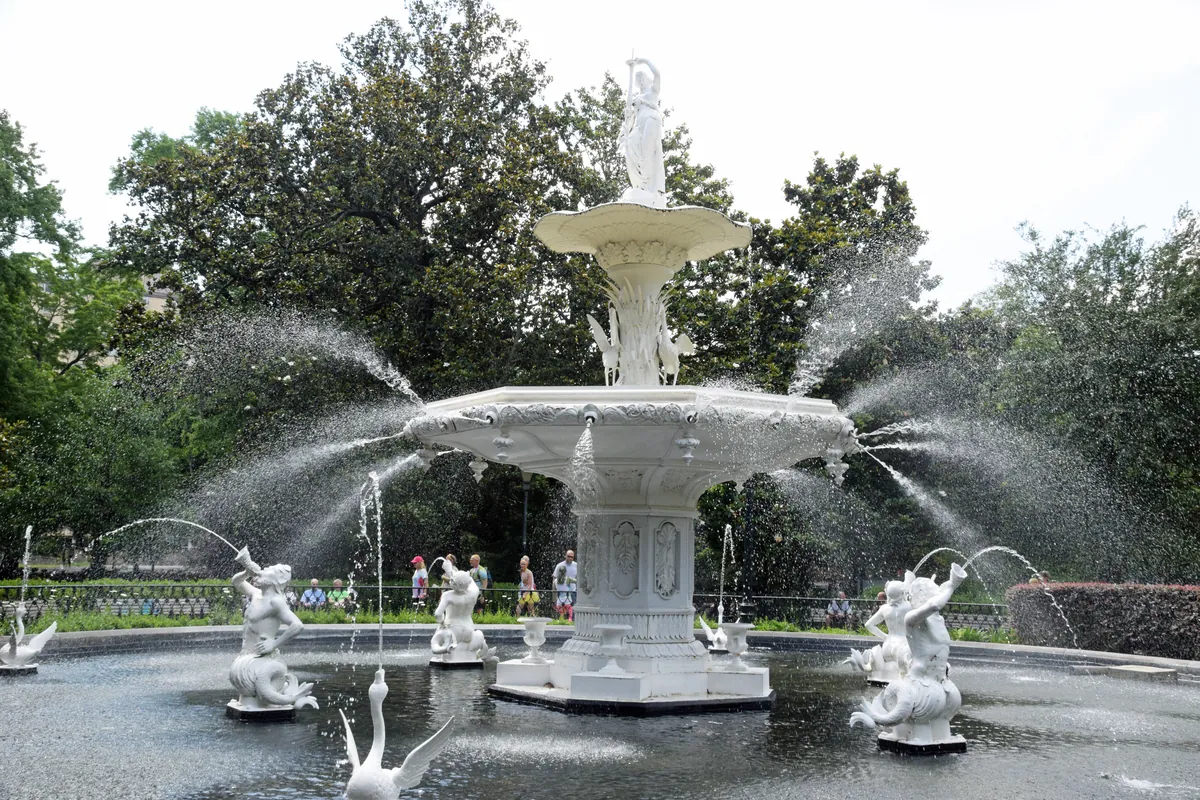
Today, Savannah is shaped by the enduring architecture of Oglethorpe's original plan. Institutions like the Georgia Historical Society, the Telfair Academy of Arts and Sciences, the First African Baptist Church, and Temple Mickve Israel, all among the oldest of their kind, mark a long history of community and culture. The city's squares, like Chippewa Square with its statue of James Oglethorpe, continue to organize its public life. Savannah retains the character of a city built on trade, shaped by conflict, and preserved by its own deliberate choices.